|
Links to Other Pages
|
| ||||||||||||||||||||
|
|
|
|
Early Photographic Processes
Ambrotype 1851-1880s |
|
|
Discovery |
The wet collodion process was discovered by Scott Archer. He published the process in 1851 and allowed its use free of copyright. The collodion process used a thin film of collodion, poured onto glass, as a base for the image. This glass plate negative that was normally used for making one or more albumen prints. However, Scott Archer and Peter Fry found that a thin glass negative could become the photo itself, if it was viewed against a black background. These photos were sometimes known in Britain as 'Collodion Positives', but are now known by the name by which they were patented in the USA in 1854 - "ambrotypes". |
|
Process |
There were two stages to producing an ambrotype:
A. Create a wet collodion
negative. B Present the negative against a dark background: 1. Selectively bleach the negative (if necessary) 2. Provide a black background, either by painting the back of the glass with shellac or mounting the the glass on top of black velvet. 3. Mount in a case behind glass, as for daguerreotypes. |
|
Result |
The Image The result was a unique image, consisting of a negative, usually underexposed, mounted against a dark background then mounted in a case. Unlike a daguerreotype, an ambrotype image can be seen when viewed from all angles. For this reason the process became popular, even though the finished result lacked the detail and tonal range of the daguerreotype. The image would be either normal or reversed (left to right) according to whether or not the emulsion side of the negative lay against the black backing. |
|
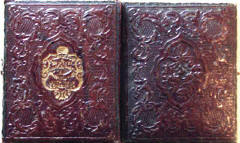
The Case Ambrotypes were often produced using one-eighth of a wholeplate (6.25 ins x 8.5 ins) sheet of glass. This gave images about 3.125 x 2.125 ins). Many of the cases in which ambrotypes were mounted, Union Cases, were made of thermoplastic with ornate patterns moulded on them. Union cases were introduced about 1853 by Samuel Peck & Co, New Haven, Connecticut, USA, and later made by John Smith in the UK. Union Cases were cheaper to produce than the earlier cases that had been used for daguerreotypes. |
|
|
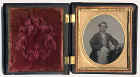
Robert Armstrong Here is an ambrotype from the studio of Robert Armstrong of 75 Princes Street, Edinburgh. Robert Armstrong was based at this address from 1855 until 1865. |
|
|
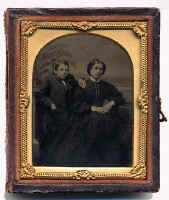
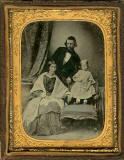
Thomas Buist Here is an ambrotype photograph of the Fife and Edinburgh photographer, Thomas Bruist. Thank you to Frances Culham, Thomas' great great grand-daughter for allowing me to reproduce this image.
|
|
|
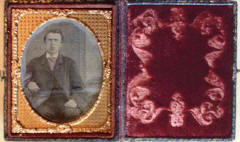
Duchauffoir & McIntyre Here is the inside and outside of a cased ambrotype from the studio of Duchauffoir & McIntyre, photographers, who were based at 33 Whitfield Place, Leith, for ten years from 1855.
|
|
|
Today |
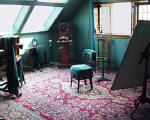
The wet collodion process is still being practiced today by Mark Osterman and France Scully Osterman. They work from the skylight studio at their home. |
|
Click here for further details of Mark and France and their early experiments, publications, exhibitions and workshops. Click here to see Mark's web site. |
|
|
Links to Other Pages
|
|
Early Photography - More pages |
|
All Pages Processes Types of Photograph Prices charged Sizes |
|
Links to Other Pages
|
Let the cursor hover over any of the buttons above and it will display further details.
LINKS: All underlined words and pictures on this site are links. Please click on any of them..
|
Links to Other Pages
|
Let the cursor hover over any of the buttons above and it will display further details.
LINKS: All underlined words and pictures on this site are links. Please click on any of them..
| ||||||||||||||||||||