|
Links to Other Pages
|
| ||||||||||||||||||||
|
|
|
|
Early Photographic Processes Tintype or Ferrotypes 1856-1940 (mainly in the 19th century) |
||||
|
Discovery |
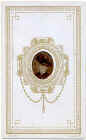
Tintype photos, as the name implies, were photos with the image on a metal surface, rather than on glass or paper. The tintype process or ferrotype process evolved from the ambrotype. It was invented by Prof. Hamilton Smith of Ohio in 1856. Ambrotype images were collodion negatives on glass, viewed against a black surface. Tintypes were negatives on on iron, coated with black paint, lacquer or enamel. Both processes relied on the fact that a collodion negative appeared as a positive image when viewed against a dark surface. A tintype was much cheaper to produce than an ambrotype, and was more durable. Tintypes would be exposed while the sensitised collodion on the metal was still wet, and would be processed immediately after being exposed - so producing an early version of the 'instant photo'. When mounted in cases, ambrotypes and tintypes can appear similar. However the two types can be distinguished by testing them with a strong magnet applied to the centre of the glass. The tintype process was patented by the American, Hamilton L Smith. The tintype process was a cheap process, used mainly by beach photographers and other itinerant photographers. The results were often low quality, so studios tended not to use tintypes, except occasionally when a small 'gem' tintype images (about 1 ins x 1 ins) were mounted into a carte-de-visite size of card. |
|||
|
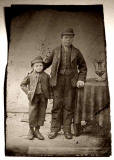
Question 1 Tintypes in Britain and America The person who sent this photo has asked when it might have been taken. Please click on the image to read more. Tintypes were produced in the USA from 1856 and became popular from the 1860s. They remained popular into the 1900s and as late as the 1920s. Tintypes in the USA were usually of a decent size (not like in the UK) and big enough to see some good detail. In UK the ambrotype (on glass) was much more common following the decline of the more expensive Daguerreotype. Tintypes were introduced commercially (by Americans) into the UK in the early 1870s and started off being very small (about 15mm across - the Gem; and 35mm across - the Victoria). By the end of the decade they had become quite popular for the cheap end of the market and they were fitted into a card the same size as the ubiquitous Carte de Visite and therefore fitted nicely into family albums. Larger tintypes in the UK were more likely to be produced by itinerant photographers (seaside etc.) because the tin was light and unbreakable and tintypes became more and more popular in the 1880s and 1890s and lasted until as late as the 1930s on some beaches. [Ron Cosens] |
||||
|
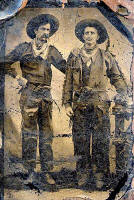
Question 2 USA or Europe tintype? Mike Maltz, Houston Texas USA, sent this tintype image to me. (Please click on it to enlarge it.) Mike is particularly interested in discovering whether this image is likely to have come from Europe of USA. If you have any views on this, please e-mail me. Thank you. - Peter Stubbs. |
||||
|
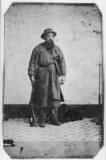
Tintype in the Civil War In America, tintypes were used by the travelling photographers following the armies of the civil war. Tin (or actually thin iron sheet) was cut to size by the photographers. The sheet was then coated with something like tar. This process was cheap, and the results could be mailed home without breaking. |
||||
|
Process |
- Coat a thin blackened sheet of iron with wet collodion on one side. - Take photo with special camera (with up to 36 lenses). - Process while still wet - Cut into small rectangles, one per photo. - Perhaps mount on card to fit a carte de visite album OR - Perhaps fit into a cheap case, possibly with glass |
|||
|
Tintype Cameras Tintype cameras would normally hold a stack of unprocessed tin plates inside the camera. They would have a device such as a rubber sucker and moving arm to raise each of the plates in turn to be exposed. After exposure, the plate would be dropped through a slot in the base of the camera into a tank that held chemicals for immediately processing the image. The chemicals would be a high strength solution that would develop and fix an image. This was designed so that the developer would work faster than the fixer, and the image would be ready to washed in about a minute. The image would normally be reversed, left to right, but some cameras included a mirror or prism that made the image appear 'right way round'. Alternatively, the photographer could re-photograph his original tintype photo in order to get an image right way round. [Details in the first two paragraphs above are based on an article by John Coathup in Photographica World, the journal of the Photographic Collectors Club of Great Britain: No 125, 2008/3, pp.24-29] |
||||
|
Result |
The Image The image of an ambrotype would be either reversed (left to right) or 'normal' depending on how the glass was mounted. However, the image of a tintype would always be reversed. Nevertheless, the tintype process was widely used for portraiture, being the cheapest form of portrait available. It was often used by travelling photographers, including seaside photographs. Some attractive tintypes in cases have been found, but typically, a tintype photo was of poor quality, with a limited range of tones, the lighter tones lacking life.
Mercury chloride
was sometimes used to whiten the image. This is about the
most deadly poison we know today. |
|||
|
Presentation A tintype is likely to be small, perhaps 1.5 x 2.5 ins, or only 1 x 0.5 ins in the case of a gem tintype. It may be: - framed in a more basic case than is used for ambrotypes OR - mounted on a card, the same size as a carte de visite to fit a Victorian photograph album OR - fitted into a locket |
||||
|
|
||||
|
In Edinburgh |
Tintypes at the Seaside Tintype photographs were often produced by beach photographers. Edinburgh is situated close to Portobello, a popular seaside resort around 1900. Several photographers had studios on the Promenade at Portobello, but I have found no Portobello tintype photos. |
|||
|
Tintypes at the Empire Exhibition However, I have a more
recent recent tintype portrait in a thin silver coloured frame
measuring Photomatic TRADEMARK USA British Automatic Co. Ltd. Empire Exhibition - Scotland - 1938. |
||||
|
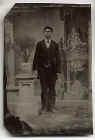
Gem Portraits Below are two a Gem Portraits - a small tintype photo mounted behind a carte de visite sized cardboard mount. The mount was often a pastel shade, with pattern. Both the gem portraits above have been produced by studios at 75 Princes Street - at the foot of Hanover Street opposite the Royal Scottish Academy Galleries. |
||||
|
Further Information |
Gem and Carte de
Visite For further information on Gem and Carte de Visite tintype photos, please see the web site of Photo Historian, Marcel Safier, Holland Park, Queensland, Australia. This web site gives a brief description of the tintype and its origin. It refers to tintype albums and lists many studios producing tintypes in the UK, USA, Australia and New Zealand. Sources of information are given and there are links to other relevant web sites. |
|||
|
Links to Other Pages
|
|
Early Photography - More pages |
|
All Pages Processes Types of Photograph Prices charged Sizes |
|
Links to Other Pages
|
Let the cursor hover over any of the buttons above and it will display further details.
LINKS: All underlined words and pictures on this site are links. Please click on any of them..
|
Links to Other Pages
|
Let the cursor hover over any of the buttons above and it will display further details.
LINKS: All underlined words and pictures on this site are links. Please click on any of them..
| ||||||||||||||||||||







![Gem Portrait from J Austin's American Gem Studio [front]](../0_P/0_photographs_austin_j_-_gem_front_small.jpg)