|
Links to Other Pages
|
| ||||||||||||||||||||
|
|
|
|
Early Photographic Processes Salted Paper Prints 1834-1850s |
||
|
Discovery |
William Henry Fox Talbot invented the salt paper print process in 1834. This process was used: - to make prints first from Talbot's photogenic drawings - from the early 1840s onwards, to make prints from calotype negatives produced by Talbot and others. - later, occasionally to make prints from collodion negatives on glass |
|
|
Process |
Create the Image 1. Immerse fine writing paper in a weak solution of common salt (sodium chloride). 2. Blot the paper to dry it.
3.
Coat the paper with a 20% solution of silver nitrate. 3. Lay the negative over the paper and expose to sunlight. |
|
|
Fix the Image 4. After exposure fix the image to ensure that it remains captured on the paper. Fixing can be achieved by using: - a concentrated solution of silver nitrate - hyposulphite of soda ('hypo') as is used today, or - one of the halides such as silver iodide. The use of sodium hyposulphite (hypo) to fix prints was known from the early days, but Talbot continued to use his concentrated silver nitrate (salt) solution. The early photographers in St Andrews also persisted with salt fixing their prints, and had difficulty achieving successful results. Later, Talbot changed to using silver bromide to fix his prints. A more popular fixer, used by others was silver iodide. Silver chloride and potassium bromide could also be used. Hill & Adamson experimented with several of these fixing solutions. 5. After fixing, wash he print thoroughly to remove the fixer and prevent it subsequently damaging the print. Some photographers washed their prints for 12 to 24 hours or longer, perhaps using 20 changes of water. |
||
|
Blanquet- Evrard's Announcement - 1851 The above is a 'printing-out process'. This is the process that was normally used. However, Louis-Desiré Blanquet-Evrard, in 1851 announced that it was possible to produce prints more quickly by developing, fixing and washing, as for a negative. |
||
|
Result |
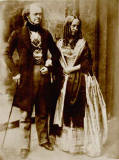
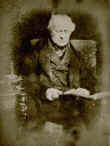
Hill & Adamson's Results The results was a small brown image, which could be delightful when well printed, though many early photographers had difficulty making successful salt prints.
The success of the process, and the amount of detail retained in the calotype depended on many factors, including the batch of paper used. Talbot often used Watman's Rag Paper. Turner's Patent Tablotype paper gave excellent results in the late 1840s and early 1850s. Much of the paper produced today includes bleaches, or even hypo, and so is not suitable for making calotype prints. |
|
|
Fading The image was very delicate and liable to fade. Fading can be reduced by the exclusion of air. e.g. when two prints have been pressed together in a photographic album, they tend to show less fading. Many of Talbot's images have faded badly. Hill & Adamson's images have survived better, apart from fading around the edges of some. This may be due to the care taken by Adamson in making the prints - possibly even due to some particular aspect of Adamson's processing. DO Hill remarked that Adamson "... thinks he knows some things others do not." |
||
|
Tones in the Print Tones of salted paper prints can vary from reddish-brown to chestnut brown; purplish brown if toned with gold chloride for greater permanence; yellowish brown if faded. They sometimes exhibit a lilac tone. This is likely to occur in prints fixed with silver chloride, and is due to incomplete removal of silver by the fixer. They sometimes exhibit primrose yellow tones. This is likely to occur in iodide-fixed prints, and is due to silver chloride having been transformed to silver iodide. |
||
|
Surface of the Print Except for those that hae been glazed or varnished with a thin coating of albumen (so producing albumenized salt prints), salt paper prints have a matt surface. The tones are embedded in the fibres of the paper. |
||
|
Waxed Paper Negatives Waxing of the negative paper enabled more detail to be retained, and prevented the fibres of the calotype negative being seen in the final print. |
||
|
In Edinburgh |
Hill & Adamson The work of Talbot in Edinburgh, Hill and Adamson and other early Edinburgh photographers is mentioned on the page describing the Calotype process.
Talbot left a documentary record of his methods for producing prints. Hill & Adamson did not. |
|
|
Museum of Edinburgh Investigations Experiments have begun at the Museum of Edinburgh, carrying out non-destructive analysis of some of Hill & Adamson's calotypes and prints looking for the levels of silver, bromide, iodine, iron, cobalt, copper, zink arsenic and other elements in these prints. This should help in determining what chemicals were likely to have been added in the smelt during the paper-making, and what chemicals were used by Adamson in making the his prints. Experiments are ongoing. It appears that Adamson appears to have experimented with different chemicals, but no 'secret ingredient' has been found. |
||
|
Acknowledgements: 1. Dr Mike Ware, who gave a lecture on chemicals used by early photographers, including Talbot and Adamson, at the DO Hill Bi-Centenary Conference. 2. Dr Kathy Eremin who gave a lecture on her team's analysis of calotypes and prints by John Adamson and Robert Adamson, at the DO Hill Bi-Centenary Conference. 3. Richard Morris, who gave a demonstration of the calotype process in Edinburgh on 11 May 02, for comments on salted paper prints. Richard Morris recommends the book: The Albumen and Salted Paper Book - The History and Practice of Photographic Printing 1840-1895 by James M Reilly. |
||
|
Links to Other Pages
|
|
Early Photography - More pages |
|
All Pages Processes Types of Photograph Prices charged Sizes |
|
Links to Other Pages
|
Let the cursor hover over any of the buttons above and it will display further details.
LINKS: All underlined words and pictures on this site are links. Please click on any of them..
|
Links to Other Pages
|
Let the cursor hover over any of the buttons above and it will display further details.
LINKS: All underlined words and pictures on this site are links. Please click on any of them..
| ||||||||||||||||||||