|
Links to Other Pages
|
| ||||||||||||||||||||
|
|
|
|
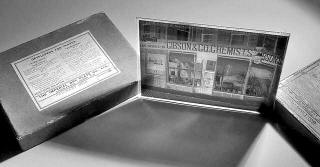
Early Photographic Processes Dry Plates Some early plates were available but not widely used before 1870. |
||||||||
|
Discovery |
1850s Around 1857, Dr Richard Hill Norris formed the Birmingham Dry Collodion Plate Company to sell dry plates. [VP:HL] But long exposure times were required for the dry collodion plates, so wet plates continued to be used for a further twenty years. |
|||||||
|
1870s Richard Leach Maddox made a significant discovery, suggesting, in 1871, that silver bromide held in a layer of gelatin should be used in preference to collodion for coating dry plates. Joseph Wilson Swan who
patented the carbon process for photographic printing in 1864 is also
credited with having invented the dry plate in 1871.
Seven years later, dry gelatin plates began to be produced in large numbers, following experiments by J Burgess and Richard Kennett, and discovery by Charles Harper Bennett of a way of treating the plates to make the emulsion more stable and far more sensitive to light [PCH] |
||||||||
|
Process |
Landscape Photography The use of dry plates considerably simplified the process of taking photographs, particularly landscapes. It became no longer necessary to travel, carrying a dark tent or with a cart or coach converted to enable the plates to be prepared immediately before taking photographs and to be processed immediately after. |
|||||||
|
Exposing the Plate All that was necessary was to: - Put the dry plate, in its plate holder, into a camera. - Slide the cover from the from the plate holder, to uncover the dry plate. - Uncover then re-cover the lens. [By 1880, the plates had become so sensitive that an exposure of a fraction of a second was often sufficient.] - Slide the cover on the plate holder back over the dark slide. - Remove the plate holder from the camera and take home for processing. |
||||||||
|
Result |
||||||||
|
In Edinburgh |
EPS Lectures Edinburgh Photographic Society debated the dry collodion process, and the relative advantages of the wet and dry processes at many of its Meetings from the 1860s onwards. Lecture titles included
Please click here to see the dates of these lectures and other titles. |
|||||||
|
1897 By 1897, attention at EPS Meetings had turned to the relative merits of slow and rapid plates. JM Turnbull claimed that slow plates should be used whenever practicable. They allowed more latitude of exposure and kept better than fast plates. FP Moffat claimed that rapid plates allowed more latitude of exposure than many people imagined. He said that the developer had a great deal to do with it. He advocated the most rapid plates for professional portrait work because 'the quicker a sitter is taken, the better' . He also advocated them for hand-camera work. [BJP: 1897, p.46] |
||||||||
|
1903 The Edinburgh photographic dealer, A H Baird, in his journal, Photographic Chat spoke in 1903 of the convenience of the gelatin plate for the amateur photographer 'who finds quite enough to look after in compassing the ends he has in view without making of himself an amateur plate manufacturer as well' However, he reported that collodion plates were still largely used in commercial work. The reason for this, he argued was due mainly to the greater sharpness available from collodion plates, and the fact that they suffered less from halation than gelatin plates with their thicker coatings. [Photographic Chat: April 1903, pp.5-6] |
||||||||
|
1911 In his EPS T Mackintosh gave an insight into the early days of the dry plate. He said that dry plates were introduced in the late 1860s, but at first was so slow that many photographers preferred to continue using wet plates. He added: "The only advantage of the slow plate, so far as I am aware, was that if our friend the photographer was taking what the poets call a sylvan glen, he might expose the plate, pose himself in the centre of the subject, and after an interval of fifteen minutes or half an hour, return to his camera and replace the cap." |
||||||||
|
Links to Other Pages
|
|
Early Photography - More pages |
|
All Pages Processes Types of Photograph Prices charged Sizes |
|
Links to Other Pages
|
Let the cursor hover over any of the buttons above and it will display further details.
LINKS: All underlined words and pictures on this site are links. Please click on any of them..
|
Links to Other Pages
|
Let the cursor hover over any of the buttons above and it will display further details.
LINKS: All underlined words and pictures on this site are links. Please click on any of them..
| ||||||||||||||||||||