|
Links to Other Pages
|
| ||||||||||||||||||||
|
|
|
|
Early Photographic Processes Gum Bichromate Process Popular: 1894 to 1920s |
|
|
Discovery |
Mungo Pontin discovered the theory of the process and experimented with gum printing in 1839. John Pounces, around 1858, is also credited with having discovered the process. [William A Foster web site] However the process was not introduced more widely until 1894. It remained popular until the 1920s, but is still practiced by some enthusiasts today. |
|
Process |
1. Dissolve gum arabic in water and mix it with a pigment and a solution of potassium bichromate or ammonium bichromate. 2. Coat this solution evenly onto a sheet of paper, and allow the paper to dry. 3. Lay a negative on the paper, and expose to sunlight or ultra violet light. The surface will harden in proportion to the amount of light that it receives. 4. Lay the print in water and allow the softer surfaces to be washed away, leaving colour in the highlights. |
|
In order to achieve more satisfying results, the photographer sometimes repeated the process above, using the same sheet of paper, but a different colour of pigment, exposing either the whole negative or chosen parts of it to the new colour. In doing this it is important to ensure the negative is placed in exactly the same position over the paper for each exposure. |
|
|
Result |
The gum bicarbonate process was popular for the creative control that it gave photographers over the final result - both through the possible use of more than one pigment and in the ability to control the amount of pigment left on the paper at step 4 above using a brush or by directing the water flow. |
|
In Edinburgh |
Mungo Pontin who discovered the gum printing process was the Secretary of the Royal Bank of Scotland in Edinburgh. |
|
Today |
See Terry King's 'Hands on Pictures' web site for news of photographers using the process today. |
|
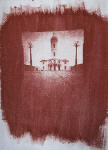
In December 2003, members of the Scottish Society for the History of Photography visited Hospitalfield House, Arbroath, Scotland, and saw some experiments that had been carried out in early photographic processes by Norma Thallon, Artist in Residence, including the gum bicarbonate print below: |
|
|
1. Some of the details above are based on information in the book: Looking at Photographers - A Guide to Technical Terms (Gordon Baldwin) 2. Terry King's 'Hands on Pictures' web site gives further details on the process and for some examples of gum bichromate prints. |
|
|
Links to Other Pages
|
|
Early Photography - More pages |
|
All Pages Processes Types of Photograph Prices charged Sizes |
|
Links to Other Pages
|
Let the cursor hover over any of the buttons above and it will display further details.
LINKS: All underlined words and pictures on this site are links. Please click on any of them..
|
Links to Other Pages
|
Let the cursor hover over any of the buttons above and it will display further details.
LINKS: All underlined words and pictures on this site are links. Please click on any of them..
| ||||||||||||||||||||