|
Polton Farm |
|
Lantern Slides A H Baird, 37+39 Lothian Street, Edinburgh |
||
|
Farm Workers *** |
||
|
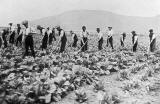
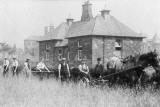
*** On further investigation (see B below) this photo appears to have been taken at the City Hospital in Edinburgh, rather than at Polton Farm |
||
|
Old Photos from Peter Pringle who was born at Polton Farm in 1947 |
||
 ©
© |
||
|
Polton Farm |
||||||||||
|
Please scroll down this page OR Click on one of the links below to read more about each of these topics:
|
|
Polton Farm and Royal Victoria Hospital Colony Recollections |
|
A. Recollections 1. |
|
Matt Rooney asks the question: "As regards your Polton Farm, is it the one off the Lasswade to Rosewell road? I used to go to that Polton Farm as a wee boy. The Farmer at that time was one of the first to get a wee grey Ferguson Tractor, it was a fascinating place for me, and I used to spend hours there as a boy." Matt Rooney, Ayrshire Scotland: April 25, 2006 |
|
Reply to A. Recollections 1. |
|
George Smith wrote: "The photo of Polton farm engaged my interest as the building behind the workers appears to be some sort of institution and it has ventilators in the roof similar to those in malt houses; some sort of hospital building requiring strong ventilation?" George Smith, British Colombia, Canada, April 27, 2006 |
|
A. Recollections 2. |
|
Matt Rooney wrote "Now, I'm Not Sure how far up the Lasswade to Rosewell Road the ' Polton Farm' that I knew went, but part way along that stretch of road there was a Children's Home. I cannot Remember what the building looked like but as far as I know it was still there the last time I passed by. You can see part of the small estate from the the Bonnyrigg to Rosewell road just above the 30 mile limit signs at the Rosewell end. There used to be a path from that road to the House. The Next time I go to Dalkeith, I'll take a better look at it. Matt Rooney, Ayrshire Scotland: May 1, 2006 |
|
A. Recollections 3. |
|
Matt Rooney wrote: "I'm still trying to discover if 'Polton Farm' in the photos above is the same 'Polton Farm' as I knew. I used to go to Willie Pringle's farm at Polton after school and at the weekends. It was Willie who bought the first wee grey Ferguson tractor in the area. I used to drive buses for William Stewart and did the 'Tattie Run' with him." Matt Rooney, Ayrshire Scotland: May 18 + 27, 2006 |
|
A. Recollections 4. |
|
Matt Rooney wrote "In the Old days the farmers used to hire extra squads of workers to help with the harvest on the farm, and the Pringle family would be no exception. During the War it was the P.O.W.'s that got that privilege. I met a lot of them at the farm." Matt Rooney, Ayrshire Scotland: June 4, 2006 |
|
A. Recollections 5. |
|
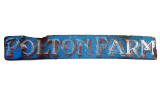
Thank you to Peter Pringle, one of the Pringle family who lived at Polton Farm, for contacting me. Peter wrote: "My brother found this Polton Farm sign in his shed recently." Peter Pringle, Bonnyrigg, Midlothian, Scotland: February 27, 2012 |
|
A. Recollections 6. |
|
Thank you to Grenville Collins, Central London, who wrote: Royal Victoria Hospital Colony Polton, Lasswade "Recently I have acquired a group of 19 real photographic postcards of the Royal Victoria Hospital Colony, Polton, Lasswade. From two of these photos, it is possible to affirm that the Royal Victoria Hospital Colony was at Springfield House, Polton, Lasswade, Midlothian." Springfield House "Springfield House was very much larger than the much smaller building that has been illustrated below in Section B of this page. It even had a very tall flagpole extending from the roof of the porch to well above the roof-line of the very substantial three storied Georgian style house. Since it has proved impossible to find an illustration of Springfield House online presumably it no longer exists." Staff and Patients "Amongst this fascinating group of images there are pictures of: - staff - patients - outside TB patients - sun bedrooms enclosed on 3 sides with glazed rooves - a 'Votes For Women' poster' ! - potato harvesting - a field with a few stouks - the interior of the piggery - ploughing and sowing - chickens' coops and so it goes on." Grenville Collins, Central London: July 23, 2016 |
|
Which Building is in this photo? |
|
B. Which Building? 1. |
|
Fay Morrison, Loanhead, Midlothian, wrote to Matt Rooney: Was it Polton Farm? "Good News. I can confirm that the farm in the picture is indeed the farm you remember as a child . However the farm as such no longer exists. Part was given over to housing and part was kept as a nature reserve." Fay Morrison, Library Headquarters Loanhead, Midlothian: May 29, 2006 |
|
Note: The answer above refers to the farm, rather than to the buildings. See below. - Peter Stubbs |
|
B. Which Building? 2. |
|
Neil Stewart wrote to Matt Rooney on May 29, saying: Was it Rosslynlee Hospital? "I believe the building in the background in the picture is in fact Rosslynlee Hospital, not Polton Farm, and that the workers would have been inmates or patients" Neil Stewart, May 29, 2006 |
|
B. Which Building? 3. |
|
Matt Rooney added, on June 4: Was it Midfield Children's Home? "The building in the photo is clearly not Polton Farm. I remember the farm buildings as being stone but I'm not sure about the house. If I find out any more I'll let you know. But I doubt that the boundary of Polton Farm stretches as Far as Rosslynlee Hospital, and if I'm right the fields round about the hospital were sort of hilly. I Still remember the wee open cast at the crossroads, where the opposite road went to a smallholding called 'Barleydean' the main road to Rosewell and Howgate. I believe that the building in the picture must be MIdfield Children's Home that is sort of wedged between the fields of Polton Farm and, I think, the fields of the farm nearer to Rosewell. I hope to take a Trip up to Dalkeith next week and go via the back road so that I can take a closer look at the Home and its Buildings. Since the slides were taken in those early days, an avenue of trees has grown." Matt Rooney, Ayrshire Scotland: June 4, 2006 (3 more e-mails) |
|
B. Which Building? 4. |
|
Alan Wilson, Edinburgh, wrote: Was it the City Hospital Isolation Cottages? "I've been having a look at the Farm Workers photo and feel fairly sure that the buildings in the background are part of the old City Hospital, which has now been converted to private housing. I worked there for a number of years in the Infectious Diseases Unit until we transferred to the Western General in 1998. I've had a word with one of the consultants and he's sure that the building immediately behind the men is one of the isolation cottages. If you have a minute to spare and happen to be in the Central Library have a look at "The Edinburgh City Hospital" by James A Gray, on page 122 there's a photograph of one of the isolation cottages which is very similar to the building in the photo, and on page 145 there's another photo showing the complete hospital with the isolation cottages on the right hand side." Alan Wilson, Trinity, Edinburgh: June 6, 2006 |
|
Further Research Needed I've not yet had chance to look at the book you refer to at Central Library. However, the glass slides above is labelled 'Polton Farm', so perhaps there were isolation units at Rosslynlee Hospital (which is close to Polton Farm) that were similar in architecture to those at the City Hospital. Maybe the same architect was used for isolation units at several hospitals, just as the same architect was used to design many of Edinburgh's schools in the late 19th century. Peter Stubbs, June 8, 2006 |
|
B. Which Building? 5. |
|
Matt Rooney added: It was probably not Midfield Children's Home? "Its been established (well! sort of) that the fields belong to Polton Farm because of 'the slides' . But I'm unsure now that the buildings are of Midfield House. I think that at Midfield there was just the one building at the end of the drive. What I cannot understand is how, if it is Rosslynlee, that the buildings are adjoining the farm as there's another farm at Hawthornden betwixt the hospital and Polton, unless of course these are absent fields as can happen on some farms. 'Absent fields' are plots of land leased by one farmer from another, if the farm does not have enough ground. Perhaps they are given a different name in your part of the country." Matt Rooney, Ayrshire Scotland: June 9, 2006 |
|
B. Which Building? 6. |
|
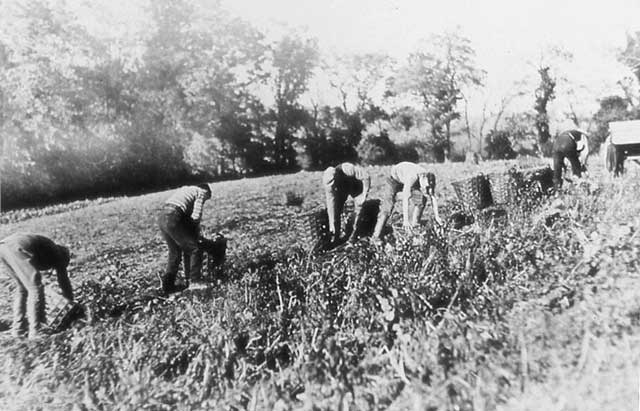
James Watson Pringle who lived on Polton Farm for eighteen years and now lives in Canterbury, Kent has provided the following answers: The Building "Unfortunately the picture of the farm workers does, not show Polton Farm, I think it is Roslynlee Hospital, but I am not sure. I will have a dig through my old photos to see if I have one of the farm. The Cabbage Workers "I don't think this photo of the cabbage field is on the farm." The Potato Workers "But this photo of the potato workers was taken on the farm. Just behind the trees is the road to Polton village and the paper mill. James Watson Pringle: Canterbury Kent, England: June 11, 2006 |
|
B. Which Building? 7. |
|
|
Bryan Gourlay, Biggar, Lanarkshire has now done some further research. Bryan wrote: Was it part of the Royal Victoria Hospital? "The attached extracts from Lothian Health Board papers suggest there was a colony at Polton Farm which was part of The Royal Victoria Hospital, called Royal Victoria Farm Colony. Perhaps this is the building under discussion at the moment." |
|
|
Bryan quoted from the Lothian Health Board papers:
|
|
|
Bryan added: "Rosslynlee Hospital seems to have been a separate entity associated with lunacy, which became part of the Royal Edinburgh Hospital." |
|
|
Bryan Gourlay, Biggar, Lanarkshire: June 13, 2006 |
|
B. Which Building? 8. |
|
Eileen Cameron wrote: Was it part of the City Fever Hospital? "This picture looks to me like Edinburgh City Fever Hospital, especially from the ward in the background. The hospital ground had at least one field still being ploughed and sown, near the West gate, when I was there in 1948, although obviously the clothing of the workers is earlier ." Eileen Cameron, Derby, Derbyshire, England |
|
B. Which Building? 9. |
|
John Stirling, Currie, Edinburgh, wrote: Tuberculosis Patients "At Polton Farm Colony in Midlothian there was a hospital for about 30 TB patients. The hospital was based at Polton House. I think it had about 30 TB patients." The City Hospital John has also provided several slides, from the early 1900s, of an isolation hospital in Edinburgh. I hope to add these to the EdinPhoto web site soon. Commenting on these photos, John said "Some of these photos are quite likely to be of the City Hospital in Edinburgh." John Stirling, Currie, Edinburgh: December 2, 2009 |
|
The City Hospital Looking now, more closely at this photo, and particularly the buildings in the background, I now agree with the suggestion that others have made - that the photo would have been taken at the City Hospital (despite being labelled Polton farm). I've now added the photo below to the City Hospital page on the EdinPhoto web site. Peter Stubbs, Edinburgh: December 5, 2009 |
|
B. Which Building? 10. |
|
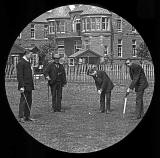
John Hadden, Edinburgh, wrote: City Hospital Buildings "Photos of the City Hospital seem to be scarce. However, some of the buildings in the background of this photo are a reasonable match to the buildings in this photo of putters, below, taken in front of the City Hospital." "Although the City Hospital is no more, these buildings still exist and are now called Rattray Grove and can be seen at this Google Maps page." John Hadden, Edinburgh: December 3, 2009 |
|
The City Hospital I agree, John. I visited the Rattray Grove, the site of the old City Hospital, yesterday. It now has a good mix of old buildings and new housing, the old having been refurbished and converted to housing. They look to be in good condition after a little more than 100 years. I now believe there is no doubt that both the photos above were taken at the City Hospital. Peter Stubbs, Edinburgh: December 5, 2009 |
|
Polton Farm Willie Pringle and Family |
|
C. Willie Pringle and family 1. |
|
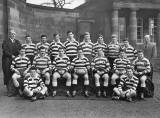
I received another e-mail about Polton Farm on May 31, 2006. Bryan Gourlay now living in Biggar, Lanarkshire, wrote: James Watson Pringle "It never ceases to amaze me that I have some sort of shared experience with many of your contributors. I've been reading the developing story of Polton farm with great interest, particularly now that Matt Rooney has mentioned the farm owner was Willie Pringle. A classmate of mine at the Royal High School between 1954 and 1960 was a James W Pringle who came for Polton. If my memory serves me well, he lived at Polton Farm and I think he was maybe the farmer's son (his middle initial could well be for William). He was never called James, or Jim or Jimmy. Throughout his entire time at school, he was always just known as 'Polton'. James Pringle certainly lived at Polton, as he used to get off the bus at the Polton road end with Lasswade Road, when we returned from playing rugby against the Borders' schools. As I recall, 'Polton' was a pretty good, swift winger. He is the second player from the left in the back row of this 1958/59 Royal High 1st XV photo." |
|
Please click on this photo to enlarge it. Royal High School Rugby Team 1958-59 Bryan Gourlay, Biggar, Lanarkshire: May 31, 2006 |
|
C. Willie Pringle and family 2. |
|
Marilyn Hamilton, Stockport, Cheshire wrote: The Pringle Family "Willie Pringle was my uncle and James Watson Pringle (known as Watson to his family) is my cousin. I've forwarded the 'Recollections' part on Polton Farm to him. I hope he will be able to contribute some stories about his time on the farm. James (Watson) now lives in Canterbury. He has three brothers, John and Peter still live in Bonnyrigg and David living in Kirknewton." Life on the Farm "As we lived in one of the farm cottages and I spent all my spare time with my cousins playing on the farm. Neeps and Tatties "I can remember also playing on Tom Black's farm next door (children Helen, Sheila and Robert). Sad to see the original Polton Farm is no longer there as it was such a landmark and large employer of local people who worked on the grain harvest, as well as "shawing neeps" and "howking tatties". Farm Buildings "There was also a dairy in the farmyard where Christine McLean used to bottle and sell milk. Her father Hughie was the cattleman and it was a familiar sight to see him bringing the cows down the road for milking. There was a stack yard for bales of straw and hay, where the tractors and trailers were parked, a Dutch barn, a piggery, a silo, 2 byres, a bull pen, and numerous barns set round a central courtyard." Midfield Home "I also remember Midfield Home as a neighbour of ours adopted a little girl from there, and when I asked her what she wanted for Christmas she replied, "A brother". She got her wish as her parents adopted a little boy from Midfield just in time for Christmas." Marilyn Hamilton, Stockport, Cheshire: June 11, 2006 |
|
C. Willie Pringle and family 3. |
|
On June 11, 2006, Robyn Pringle wrote James Watson Pringle "Hi I just thought I'd drop you a line to let you know that the JW Pringle mentioned on your site about Polton Farm, is my father. His name is James Watson Pringle and as mentioned he never used James and answers to Watson, he was know as Polton in his younger days. He has 3 younger brothers John, Peter and David all of whom still live in the Edinburgh area. Dad is now living in Canterbury, but still makes regular visits to Lasswade. I have told Dad about this site and he will no doubt be in touch soon." Robyn Lait: June 11, 2006 |
|
C. Willie Pringle and family 4. |
|
James Watson Pringle, Canterbury wrote: "I lived in Polton Farm for eighteen years. It is great to hear about the farm after such a long time, it was knocked down in 1963 give or take a few years. Prisoners of War "I remember very well the Italian prisoners of war who helped on the farm. There were many hilarious events. The Italians were very good craftsman they carved ornate toys and mobiles, they were mostly very happy but used to moan about having to work. One day they downed their hoes and refused to work. Jock Anderson asked me to get the sergeant who was having a cup of tea at the farmhouse. When I told him he said 'Don't worry I'll sort out in a tick.' He picked up his rifle and sauntered up the road. As soon as the sergeant appeared at the gate of the field, the prisoners picked up their hoes, and started working without saying a word. It was either at the end or just after the end of WWII and everybody knew the rules." Message for Matt Rooney You are correct it stood on the Lasswade to Rosewell Road on the right hand side one hundred yards above where the Polton Inn is now. Message for Bryan Gourlay It was also good to hear from Brain Gourlay, the photo of me in the rugby team Brain bears little resemblance to me now. James Watson Pringle, Canterbury, Kent, England: June 11, 2006 |
|
C. Willie Pringle and family 5. |
|
James Watson Pringle, Canterbury wrote: "I lived in Polton Farm for eighteen years. It is great to hear about the farm after such a long time, it was knocked down in 1963 give or take a few years. Prisoners of War "I remember very well the Italian prisoners of war who helped on the farm. There were many hilarious events. The Italians were very good craftsman they carved ornate toys and mobiles, they were mostly very happy but used to moan about having to work. One day they downed their hoes and refused to work. Jock Anderson asked me to get the sergeant who was having a cup of tea at the farmhouse. When I told him he said 'Don't worry I'll sort out in a tick.' He picked up his rifle and sauntered up the road. As soon as the sergeant appeared at the gate of the field, the prisoners picked up their hoes, and started working without saying a word. It was either at the end or just after the end of WWII and everybody knew the rules." Message for Matt Rooney You are correct it stood on the Lasswade to Rosewell Road on the right hand side one hundred yards above where the Polton Inn is now. Message for Bryan Gourlay It was also good to hear from Brain Gourlay, the photo of me in the rugby team Brain bears little resemblance to me now. James Watson Pringle, Canterbury, Kent, England: June 11, 2006 |
|
C. Willie Pringle and family 6. |
|
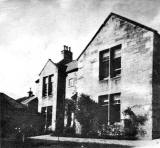
On May 11, 2009, Peter Pringle wrote: Polton Farm "I was born at Polton Farm in 1947. I was the third of four Pringle sons to William and Barbara Pringle. I notice there is some confusion on the site regarding a picture of what is thought to be Polton Farm. This picture should put things straight. It is a genuine picture of the farm building. The farm building was built in 1888 by a local architect, Robert Dundas. If anybody has any other information on this architect, or knows of any drawings of the building, that would be of interest to me. Here is another photograph taken at the farm. The farm was eventually sold to George Wimpey and the local council for housing purposes in the early-1960s." Peter Pringle, Bonnyrigg, Midlothian, Scotland: May 11, 2009 |
|
The Architect I've checked the book "The Buildings of Scotland, Edinburgh" (John Gifford et at). The book does not list any buildings in Edinburgh by Robert Dundas but perhaps somebody else will know more about this architect. If you do know more, please email me, then I'll pass on your message to Peter Pringle. Thank you. - Peter Stubbs: May 15, 2009 |
|
C. Willie Pringle and family 7. |
|
David Webster wrote: Watson Pringle "My clear recollection is that James Watson Pringle was never really known as James. He always went as 'Watson Pringle'. I can also identify others in the photograph of the Royal High Rugby Team that includes Watson Pringle. Rector, Dr Imrie On the left side, when looking at the photo, is the Rector of the School, Doctor Imrie Curly Mitchell On the right is 'Curly Mitchell', Head of PE - Royal High School at Regent Road. His nick name was well known around the school and he was also well titled for that shiny bald patch. If you were ever asked to report to Curly's room for some misdemeanour, it was more than likely you would 'get the slipper' - he stood no nonsense. He kept himself very fit and could be seen most days running about the school in his track suit and gym shoes! (no designer trainers in those days) and was an example to many of us on fitness. He played regularly in the annual Masters Rugby Team against the boys at Jock's Lodge. There were many issues addressed during these games! David Webster: December 25, 2009 |
|
C. Willie Pringle and family 8. |
|
Alison Watson Ewing wrote: Polton Pig Farm "I was really excited to find this page. I lived at Polton Pig Farm from my birth in 1946 until my family emigrated to America in 1959. Polton Pig Farm was very near the dairy run by Willie Pringle. I knew this Pringle family quite well. My parents were George & Jeanie Watson. I was in the same class as John Pringle, the brother of Peter who submitted some photos to you. My brother was in the same class as Peter Pringle. Alison Watson Ewing, Wellsville, Utah, USA: July 19, 2011 |
|
C. Willie Pringle and family 9. |
|
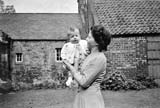
Peter Pringle wrote: Buildings near Polton Farm "This group of buildings stood half a mile east of Polton Farm. It consisted of a barn, accommodation for workers, implement sheds and stables at the very edge of Broomieknowe and behind the Knowe Hill. When the second world war finished the local council started to buy the land surrounding East Mains. The council houses built soon isolated these buildings from thier original purpose and gradually they were used less and less. However people still lived in the cottages . In 1939 my parents married and moved into the cottages there and in the following year thier first son was born. This picture was taken in the courtyard. Peter Pringle, Bonnyrigg, Midlothian, Scotland: July 31, 2011 |
|
Polton Farm Poem |
|
D. Poem 1. Matt Rooney has sent me his poems on many subjects over the past few years. Here is one of them. Matt writes: "Here is a poem for the Pringle family as a thank you for my memories of Polton Farm:" |
|
D. 1. Memories of Polton Farm "The days before the tractor were fraught with danger from all airts you know, As fingers could get trapped within the thresher's inner glow. Then, the coos in for the milking could clatter you across the shins, As the maid who'd tethered the bull laughed, as it kicked against the bins." "The ploughing was hard graft when the furrow's were on a hill, And the birds gathered at one end then went into overspill. The farm house was always busy, I mind that full well, And the reek of the mornings porridge with creamed milk was for us the better sell." "Going to the tatties was worse in the cold and rain, With sacks provided as an apron and back groanin' wi' the pain. The olden days are good, now that we no longer have to toil As modern implements are harrowing the fields among the same old soil" Matt Rooney, Ayrshire, Scotland: June 13, 2006" |
|
Farms around Polton |
|
E. Farms around Polton 1. |
|
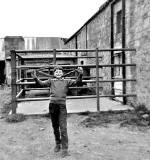
Thank you to Pat Reid, Edinburgh, formerly Bonnyrigg, for sending me her recollections of farms around Polton. Pat wrote: Pringle's Farm Poltonhall, Bonnyrigg "I've just been browsing the recollections and comments about Pringle's farm in Poltonhall, Bonnyrigg. I grew up in Dalhousie Drive, Poltonhall, and Pringle's farm was just off Polton Avenue Road which ran along the top of Dalhousie Drive. Many happy days spent playing and cycling round and round the 'blocks' as we called them. I have happy recollections of the families in the 'Drive' too - Marin, Scanlan (2 families - cousins) - Miller (2 families, not related, but one of the families were my cousins) - Dunn - Crawford - Grimley - Campbell - McDonnell - Allison - Thomson - Ritchie - Cherrie - Lyall - Lindsay - Templeton - and more whose names I can't recall at the moment. We were the Taylors. Pringle's farm cow fields were just at the top of Dalhousie Drive too on the other side of Polton Avenue Road and we often, as children, watched the cows being taken in for milking. Pringle's Dairy supplied milk to many of the houses in Poltonhall in competition to St Cuthbert's Dairy. In fact, most of the local boys did their turn on the Pringle's milk float when they were growing up. One of my brothers certainly did! We used to get sent up to Pringle's dairy for milk when the shops were shut and we'd run out. You had to pass the Piggery to get into the dairy as I recall and I hated having to go. I just took to my heels and ran past the pigs trying not to look at them. Here is a photo of my young brother, Robin, at Pringle's farm standing in front of what I always thought was a bull pen but I might be wrong." Pat Reid, Edinburgh: Message posted in EdinPhoto guest book: December 7, 2008 |
|
E. Farms around Polton 2.
|
|
Thank you to Peter Pringle, who was born on Polton Farm for sending this reply. Peter wrote: Reply "Pat: You're not wrong. The photo above is of the bull pen at Polton Farm." |
|
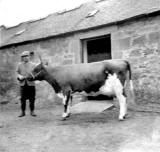
Here, Peter tells some of his memories of the bull pen: Bull and The Cows "Being a dairy farm, the milking cows had to be served by the bull. First, the bull was enticed into the metal pen. A sliding gate was used to keep the bull in the metal pen, outside. At this point the dairy cow was introduced into the inner pen. The sliding gate was now moved upwards to allow the bull access to the cow. - Hey Presto! Willie Pringle's Accident "On one occasion, after the bull had serviced the cow the sliding gate was raised to try to remove the bull. The bull was stubborn on this occasion and would not come out. My Father, Willie Pringle, decided to get into the metal pen and use a turnip to try and entice the bull out, so that the gate could be closed again. A turnip! He might as well have been using a red flag. The bull now charged from the inner pen to the outer pen with my father as the target, resulting with each of his upper legs being broken, and massive bruising. I think the bull pinned him to the wall. Fortunately he wasn't killed. There's a moral in this story. This practice was never carried out again. I think the bull was destroyed soon after this incident." Peter Pringle: May 18, 2009 |
|
E. Farms around Polton 3. |
|
Pat Reid wrote: Black's Farm "Black's farm, situated to the rear and side of Pringle's, which I think stretched down to Lasswade too, was a temptation for us youngsters when we were out for a walk.
Indeed, one day, my cousins and I were
caught stealing tumshies (turnips) by Farmer Black and given a good
telling off. Luckily he knew our parents and didn't feel the need to
call the 'polis'. Pat Reid, Edinburgh: Message posted in EdinPhoto guest book: December 7, 2008 |
|
E. Farms around Polton 4. |
|
Pat Reid wrote: Chester's Farm "The Chester's farm, further up from Poltonhall on the road to Rosewell, was where we were sent when Mum needed eggs. You had to cross the railway at the level crossing to get into the Chester's. There was also a place in that vicinity which we called 'The Kinnegars' where we used to pick brambles, raspberries, strawberries, blackcurrants which all grew wild. Mum made jam often from our efforts. Also, we used to collect rosehips and sell them to the school Headmaster, Mr Hector MacPherson, a formidable gentleman, who gave us 6d per pound. I expect the rosehips were then sold on to make rosehip syrup. We never really knew. We just enjoyed the money they earned us every year. Pat Reid, Edinburgh: Message posted in EdinPhoto guest book: December 7, 2008 |
|
E. Farms around Polton 5. |
|
Pat Reid wrote: Tam Muir's Farm "The fourth farm in Poltonhall was Tam Muir's. I can recall another of my brother's working there at harvesting time every year. I think Tam Muir was a farmer who didn't take kindly to anyone trespassing on his land, so we stayed away. Pringle's, Black's and Chester's farms were more user friendly (although we didn't know what that meant back in the 1950/60s). |
|
Pat ended: Happy days. With best wishes to all who might see this, that it may stir their memories of happy childhood. |
|
Pat Reid, Edinburgh: Message posted in EdinPhoto guest book: December 7, 2008 |
|
E. Farms around Polton 5. |
|
Thank you to Charlie Cummings, now living in Bolton, Manchester for leaving a message in the EdinPhoto guest book. Charlie wrote: Poltonhall Neighbours "I lived at No: 3 Dalhousie Drive, Poltonhall. Willie and Helen Cummings are my parents. When we first moved in: - the Taylors were our neighbours. - Mrs Marion and Mrs Moody stayed across the road. I remember: - the Millars - the Thompsons - the Dunns - the Alisons. |
|
Chester's Farm Polton "Henry Renwick was the owner of the Chester's Farm. My mum and dad worked on the farm, I remember picking tatties on the farm during the October week with the other kids from the neighbourhood." |
|
Charlie Cummings, Bolton, Manchester, England: Message posted in EdinPhoto Guest Book, December 17, 2008 |