|
Jerome's Studios and Gale Studios including experiences in studios
Liverpool and other studios |
|
1. |
Geoff Welding |
- Early 1960s - Camera - Taking the Photo - Lens - Shutter - Paper - Tripod - Passport Photos - Babies |
|
2. |
Geoff Welding |
- Gale's Studios |
|
3. |
Peter Stubbs |
- Gale's Studios |
|
4. |
Richard H
Leonard with reply from
Peter Stubbs |
- Gale's Studios - Liverpool & Manchester |
|
- Gale's Studios Ltd - George Gale |
||
|
5. |
- Colonel Bertram Gale - Jerome Studios Overseas |
|
|
6. |
- Mrs Florence Julita Gale |
|
|
7. |
Geoff Welding |
- Jerome Photos |
|
8. |
Geoff Welding |
- Jerome Photos |
|
9. |
Dirk Boonstra |
- Gale's Studio, Rotterdam |
|
10. |
Philip Squires |
- Jerome's Studio |
|
11. |
- Jerome's Studio in France |
|
History 1. Geoff Welding Cheshire, England |
|
|
Thank you to Geoff Welding for sending me his recollections of working in Jerome's studios for two years from 1960. For the following six years, from 1962, Geoff worked for Littlewoods Mail Order photographic studios in Old Hall Street, Liverpool. He is now a professional photographer. He is based in Cheshire, but works on location throughout Britain. Here is a link to Geoff's web site and here is a web page that includes a photo of Jeff, aged 17, in Jerome' Liverpool studio. |
|
|
Recalling his time working for Jerome's, Geoff wrote: Early 1960s "I worked as a photographer, mainly at Jerome studios in Liverpool, from 1960 to '62, but I did some occasional relief work at Jerome's Manchester branch on Market Street before becoming sole photographer at their London Road branch in Liverpool. It's now over 45 years ago, but I'll try to remember as much as I can about the equipment. Camera "I don't remember seeing the manufacturer's name on the camera but it was well made, wooden, probably teak, with a front brass-hinged double baseboard and square bellows. The lower base board was attached to the tripod and the rear of the upper base board could be raised by about 35 degrees, so the camera could look down on the subject. This arrangement was mainly used for looking downward on babies who were laid on their backs or stomachs on a table top covered with a blanket. Taking the Photo "The camera back had a focusing screen approx 3.5x2.5 inches. It revolved for portrait or landscape format. Having focused on the subject, using a brass wheel and rack arrangement, the teak plate holder would be inserted into wooden groves in the camera back. This would then push the focusing screen further along the groves. With the plate holder having taken the place of the screen, you would be ready to pull out the dark slide and take your first photograph. Each plate holder was big enough to take 3 exposures. This was done by moving the holder further along the groves each time. A brass clip would slot into the holder making sure it was aligned for the next photograph." Lens "The Dalmeyer f5.6 lens had a focal length of 9 or 10 inches. We had ours set at f6.3. I would give at least a one second but preferably longer if I was confident that the sitter would not move and was not just about to blink. A long, square metal lens hood was attached to the lens by three screws with knurled heads so you could tighten or loosen the screws with your finger tips. I think these excellent dark red lens hoods were especially made for Jerome Studios. I've never seen any since. Shutter "The shutter was a sprung flap within the bellows and attached to the top of the camera back. This was operated by an actual bicycle back brake cable attached to a brass release that operated in the same way as a bicycle brake. When you squeezed it together, the flap would open towards the top of the bellows. It would then close quickly, with the aid of the spring, on releasing." Paper "The orthochromatic paper in the holder would be about 9x4 inches. It was much more sensitive to light than Bromide print paper. However taking three exposures of one sitter would be frowned on by the Branch Manager if it occurred to often, and at Head Office in Wolverhampton** if it was reported on to them."
Tripod
"The Mahogany tripod was a very Victorian
affair. I saw a very similar model in a 1868 photograph. The 6
inch wheel that racked the central column up and down would have Three curved piano stool type legs ran on casters and consequently a good shove was needed to get the camera and tripod on the move." Passport Photos "Using this equipment I often made 500 to 600 exposures on a Saturday. Fortunately, there where many passport photographs required and the customer could be in and out of the studio in under a minute, even though they may have queued for an hour." Babies "The biggest problem was very young babies. Some must have come straight to Jerome's from the Maternity Ward. Getting them to be perfectly still for even a second was difficult. However, with the aid of a squeaky toy, the photograph was eventually taken, but four minutes may have have passed. On Saturdays, queues where often around the large waiting room, into the shop and out the door on to London Road, as they were at the Market Street branch in Manchester in the 1960s." |
|
|
Geoff Welding, Cheshire, England: October 16, 2007 |
|
History 2. Geoff Welding Cheshire, England |
|
Thank you to Geoffrey Welding for also sending the message below |
|
Geoff wrote: Gale's Studios "I came across a postcard portrait today which I believe is of one of my relatives. On the back of the card is the name of the studio which is Gale's Studio. This would have been a studio in Liverpool. The message printed on the back of Jerome cards is: "JEROME. Branches Everywhere." The message printed on the back of my card is "GALES STUDIO LTD., Branches everywhere." So is this the same Col. Bertram Gale as was involved in Jerome's but also Gale's Studio at the same time in the early 1930s?" |
|
Geoff Welding, Cheshire, England; January 26, 2009 |
|
History 3. Peter Stubbs Edinburgh |
|
Thank you to Geoffrey Welding for also sending the message below |
|
Geoff wrote: Gale's Studios - Liverpool & Manchester "There appears to be good reason to believe that Col. Bertram Gale would have been involved with Gale's Studios as well as with Jerome's Studios. Both companies had studios in Liverpool and Manchester, in some cases sharing the same address: LIVERPOOL - Gale's Studios Ltd: 1916-24: 17+29, London Road - Jerome Ltd: 1920-37: 17 London Road - Jerome Ltd: 1938-40+: 17 / 19 London Road MANCHESTER - Gale's Studios Ltd: 1916-27: 54 Market Street - Gale's Studios Ltd: 1928-31: 52a Market Street - Jerome Ltd: 1930-31: 131 Market Street - Jerome Ltd: 1932-37: 52a Market Street - Jerome Ltd: : 1938-39: 54 / 56 Market Street - Gale's Studios Ltd: 1922-25: 45 + 49 Oxford Road -- Jerome Ltd: : 1922-25: 45 / 47 Oxford Road Peter Stubbs: January 31, 2009 |
|
Acknowledgement: The studio addresses above
have been taken from Gilian Jones' book: |
|
History 4. Richard H Leonard Drogheda, Co. Meath, Ireland |
|
Thank you to Richard H Leonard for sending me a copy of a photo of his grand uncle, taken at Gales Studios. The date, 1 Nov 1926, has been added to the back of this photo with an ink stamp. |
|
Richard adds: 1926 Postcard Portrait "From your website, I assume that the photo was taken in the 54 Market Street branch, Manchester. Richard H Leonard, Drogheda, Co. Meath, Ireland: February 16, 2009 |
|
Richard: Your photo might well have been taken at the Gale's Studio at Manchester that you mention, or it could have been taken at their Blackpool studio, or at one of their studios elsewhere if they had any. Gillian Jones' book, 'Lancashire Professional Photographers, 1840-1940' lists just one address for Gale's Studios Ltd in Lancashire, in addition to those I have given in 3 above. It is: Gale's Studios Ltd BLACKPOOL - Gale's Studios Ltd: 1918-32: 8 Bank Hey Street I don't know whether or not there were also Gale's Studios in other counties. The (no doubt exaggerated) claim on the back of the 1926 Gale's photo suggests that there may well have been others. It reads: 'GALE'S STUDIOS: BRANCHES IN ALL TOWNS' |
|
There was also a photographer named George Gale who operated earlier. I don't know what relationship (if any) he had to Bertram Gale. His studios were at : George Gale MANCHESTER - George Gale: 1916: 57 Market Street - George Gale: 1916-25: 47 Oxford Road |
|
Peter Stubbs: February 25, 2009 |
|
History 5. Dennis L Garrett |
|
Thank you to Dennis L Garrett who wrote: |
|
Colonel Bertram Gale "I was intrigued to read your articles about Jerome Studios which were developed from Gale's Studios in the late 1920s. My father was a close business friend of Col. Bertram Gale. One of my father's companies designed and built the interiors and shop-fronts of all the Jerome Studios. Another of his companies manufactured the cameras and enlargers for the paper negative system they used. Though a student at the time, I personally knew Col and Mrs Gale and found them delightful." |
|
Jerome Studios Overseas "You are correct in stating that Jerome's had branches all over the UK. In addition there were Jerome studios in Amsterdam, Paris and Dublin. I remember that during the immediate post-war period, my father was busy with the several new branches being opened. At this time, Jerome's Head Office was situated in Dorset Street, London. In 1953, my father sold his UK companies to reside in the USA." |
|
Dennis L Garrett: March 29, 2009 |
|
History 6. William Mason London |
|
Thank you to William Mason for sending me more information about the Gale family. |
|
William wrote Mrs Florence Julita Gale "I have a photo by the Jerome Studio of a family member Mrs Florence Julita Gale, my grandmother. William Edward Gale is the first son of Col. Bertram Gale. William Edward Gale married Florence Julita Tiltman. She became Mrs Florence Julita Gale." |
|
William asked Question "Do you have any photos by Jerome of the Gale family, especially Col. Bertram Gale? William Mason, London, Son of Elizabeth Gale, daughter of Mrs. F. J. Gale: August 14, 2010 |
|
Reply to William Mason? Unfortunately, I don't have any photos of members of the Gale family, taken by Jerome. I've sent a message to Geoff Welding (2 above) to ask if he has any. If you have any Gale family photos, can you please email me, then I'll pass on your message to William Mason. Thank you. Peter Stubbs, Edinburgh: August 15, 2010 |
|
History 7. Geoff Welding Cheshire, England |
|
I emailed Geoff to ask if he had any Gale photos from Jerome's studios. |
|
Geoff replied: Jerome Photos "I do not have any other Jerome photo's that you have not already seen. Jerome's did not make a record of customers names and when customers came back to reorder it was just the date on the back of the photograph that helped to find the negative. However you may have to look through several hundred negatives to find the right one and twice that many if the photograph had been taken on a Saturday." Geoff Welding, Cheshire, England; August 16, 2010 |
|
Reply to Geoff Thanks for your comments, Geoff. I had not thought of the dates printed on the back of Jerome postcards being of use to the studio. I am familiar with Victorian photographers using the negative number, usually written in pencil on the back of a carte de visite or cabinet print, to find a negative (without having to know a customer's name) when a reprint was requested, but I had never thought that the dates might be used in that way. I wonder why Jerome's used the dates rather than negative numbers. A negative number sounds as if it would be more helpful, leading to a single negative, rather than to a collection of several hundred! Peter Stubbs, Edinburgh: August 16, 2010 |
|
History 8. Geoff Welding Cheshire, England |
|
Thank you to Geoff Welding for giving me the answer to my question at the end of '7 above'. It's always good to receive answers like this from people who have first-hand experience, rather than speculate. |
|
Geoff replied: Jerome Photos "The simple answer to why Jerome's did not put negative numbers on the backs of their photos is 'lack of time' in the months when the studio was very busy, which was Spring to Autumn." Queues "There were occasions when not only the waiting room was full with about 60 people, but the queue would go into and through the shop and out on to London Road. Also, some customers would come early to collect their prints before the allotted time, so they would be milling around the shop area waiting as well. So, Miss Clancy the manager and her assistant needed to keep everything on the move. This gave hectic days, particularly for the three teenage staff in the darkroom and finishing area, John the printer age 18, Edna and Margaret both 17, 1961/2." Jerome Photos "So, a quick stamp on the print with the day's date before rushing out the finishing room was all there was time for. In the winter months there would have easily been time to collate the print and negative with a reference number on each, but this was never considered, as far as know - and the date system worked satisfactorily." Geoff Welding, Cheshire, England; August 17, 2010 |
|
Geoff added: Re-orders "Jerome's had several days to complete re-orders for prints before the customers would collect them - rather than one and a half hours which was the normal time for prints to be available after a photo was taken." Geoff Welding, Cheshire, England; August 19, 2010 |
|
History 9. Dirk Boonstra Netherlands |
|
Thank you to Dirk Boonstra who wrote |
|
Rotterdam Studio "I have a postcard with a photo of my grandfather. I think the photo would have been taken around 1923. On the back of the postcard is printed: 'Gale’s Studios, 159 Hoogstraat, Rotterdam'. On your EdinPhoto website I read that Gale had 'Branches everywhere'. Here are my questions: 1. Is this Gale’s studios in Rotterdam one of the many branches of the Gale mentioned in EdinPhoto? 2. Do you know the opening and closing dates of this studio in Rotterdam? This could help me in getting a better date when the photo was taken." Dirk Boonstra, Netherlands: September 1, 2010 |
|
Update Dirk contacted me on January 6, 2011 to let me know that he now knows where and when his photo was taken. It was at a wedding in Rotterdam on October 14, 1926. Peter Stubbs: January 11, 2011 |
|
Recollections 10. Philip Squires Wrexham, North Wales |
|
Thank you to Philip Squires who wrote: |
|
Jerome Studio "I worked for Jerome’s in London Road, Liverpool in 1957 as a studio photographer. The manager was Dennis Souter, and the Shop Manageress was a lady called Miss Sprung. - We used paper negs. When they had been exposed, I wrote the reference number and required print size on the reverse. - The most popular order was for Passport Photos, but we also hand-coloured and mounted portraits. - Also popular, were photos of young children in their ‘First Communion’ dresses. I passed by the location today for the first time in over 20 years, when I was on a visit to the Walker Art Gallery, just round the corner from London Road - but I think the Jerome studio building has now been demolished. I’d love to know what happened to the rest of the staff. My short experience in Jeromes started my lifelong interest in photography. The experience was invaluable, albeit very basic! Happy days!" Philip Squires, Wrexham, North Wales: November 5, 2011 (2 emails) |
|
Reply to Philip Squires? If you'd like to send a reply to Philip Squires, please email me, then I'll pass on your message to him. Thank you. Peter Stubbs, Edinburgh: November 5, 2011 |
|
History 11. Evelyne Bozzato |
||||
|
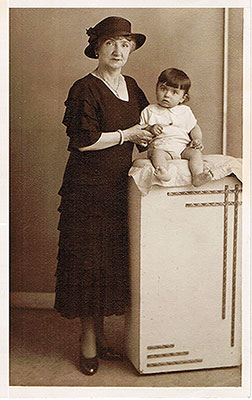
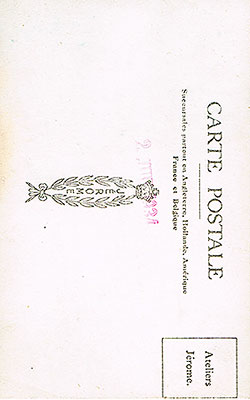
In History 9 above, Dirk Boonstra mentions the Gale's Studio in Amsterdam. Jerome Studio in France Thank you to Evelyne Bozzato, France, for sending me the two photos below, and so provides evidence that there was at least one Jerome studio in Franc The wording on the back of this Jerome postcard portrait is in French, and it mentions the locations of several Jerome studios in Europe. Thank you to Evelyne for sending me the photos below, showing the front and back of your postcard studio portrait. I was interested to see the familiar 'Jerome' logo on the back of this postcard, but the printed text in French, referring to studios in France and Belgium. Please click on the photos below to enlarge them, and be able to read the text on the back of the postcard.
|
||||
|
Question Evelyne wrote (in French), asking in which town the Jerome studio might have been where this photo was taken. She mentions that the photo was taken on June 2, 1934 and that her family lived in Villeneuve, France and that her grandmother was, perhaps, in Paris: "Bonjour. Pourriez vous me dire où a pu être prise cette photo (2 juin 1934) des ateliers Jérôme ? Dans quel studio et quelle ville? Ma famille habitait Villeneuve/LOT 47400 FRANCE mais la grand-mère était peut-être à Paris" Evelyne Bozzato, France: January 25, 2014 |
||||
|
Reply to Evelyne If you can help to answer Evelyne's question above about where this photo might have been taken, please email me, then I'll give you Evelyne's email address so that you can send a message direct to her. If you can tell me anything about Jerome's studios outside Britain, I would be happy to add the details to this page on the web site. Thank you. Peter Stubbs, Edinburgh: January 26, 2014 |
|
JEROME PAGES |