|
Growing up in Leith and Digs, Flats, Church |
|
Recollections 1. Ian M Malcolm St Andrews, Fife, Scotland |
|
Thank you to Ian M Malcolm for telling me about his accommodation in and around Leith while he was studying at Leith Nautical College in 1947-48. Ian wrote: |
|
Accommodation "In 1947, students stayed in digs, not flats. Digs were my greatest expense and an ongoing problem during my year in Leith." Rosslyn Street "Through a friend of my father, I spent the first two nights with Mr and Mrs Buchanan in Rosslyn Street. They refused any payment and even gave me a row when I went out for a meal!" Cambridge Gardens "I soon found accommodation in Mrs Emslie's terraced house in Cambridge Gardens, but didn't stay long there." Dalmeny Street "I spent a fortnight with Jim and Margaret Johnston who lived in a tenement in Dalmenny Street. They were ardent members of South Leith Baptist Church and through them I met others who became friends." Constitution Street" "At the end of August, I moved to the tenement home of Mr and Mrs Brown at 19 Constitution Street which was just below the foot of Leith Walk and much nearer the College. Although it was a poor area, the digs were comfortable and I was treated like a member of the family. The room that I stayed in had belonged to their young son, David. The wall over my bed was decorated with pictures of railway engines, secured by 1" nails. I couldn't care less about the decoration. I had a small table to work on and a small electric fire to keep me warm, all for about 30 bob (£1.50) a week. Almost everybody listened to 'Forces Favourites' at dinner/ lunch time on Sundays. My room looked out towards the back of tenements in Great Junction Street. I have a memory of hearing the recording of Frank Sinatra singing 'Time After Time' issuing from the open window of a house. Towards the end of the year, it came as a blow to learn from Mrs Brown that she was pregnant and had to dispense with boarders. It was again a case of searching for new digs." Wellington Place "When I was absolutely stuck for a place to spend a night in January 1948, Mrs Lord put me up on the settee in her living room at Wellington Place. I was absolutely freezing, but for supper, (bed) and breakfast, she charged me only 2/6d." Admiralty Street "It was early January before I got fixed up with another Mrs Brown, in Admiralty Street. But the winter was a severe one. It was so cold that I invested in heavy underwear. In the house, I had to study in the kitchen/living room, as my room, even after I obtained a small electric fire on paying an extra five bob, was perishing. I slept on the bed settee in the sitting room with more clothes on than I wore during the day. I also piled everything I could on the bed, chair backs and even a rug, but still froze. Another problem was the social life which went on in the kitchen and which made study almost impossible. On my very first evening, they had visitors in and I went to the Sailors' Home to study. There was another boarder called Charlie Thompson and, on my second night, he, the Browns and another woman, played cards with the radio on. It was an impossible situation so I gave Mrs Brown £2 and told her I was leaving because of the cold." The Sailors' Home "My last move was to the centrally heated Sailors' Home in Tower Place where I got one of the rooms in the officers’ section. There were about twenty-four rooms in the section and all but one were occupied by students at the College studying radio. The rooms, separated only by partitions, were narrow and spartan and without washhand basins. But they were adequate and there was an officers' dining room and a lounge, both overlooking the dock. The dining room was spacious and pleasant while the lounge, where we studied, was palatial with tables, leather-bound easy chairs and pictures of sailing ships on the walls. The name 'Sailors' Home' may sound ominous, but it was comfortable, warm and friendly. Dances were held there on Wednesday evenings As food rationing was still in operation, we gave our coupons to Mr MacDonald, a former Chief Steward, who was the officer-in-charge. But as the amount of food served was inadequate and we did not get the number of eggs to which we were entitled. I decided to do something about it. After consulting the others, I wrote a letter of complaint to the British Sailors' Society in Glasgow and got the others to append their signatures below mine. The letter had been sent on a Wednesday and when we went in for lunch on Friday, all our plates were so piled up that the boys were looking across to me and smiling. Nothing had been said, but what a difference! The crisis was over." Leaving Leith "I left with a great affection for Leith where I had met much kindness and where, on the very day I left the College with my brand new 1st Class PMG in my pocket, I got a friendly wave from Mr Brown who happened to be passing with his horse and cart." Leith, however, is a changed place today. Luxury flats now occupy The Shore and the Sailors' Home, at the dock gate in Tower Place, is now the Malmaison Hotel. Above its entrance the words Sailors’ Home are still faintly discernible. The Kirkgate (pronounced Kirgit by the locals) has all but disappeared as have the consulates in Bernard Street which once signified a lively port trading with the Continent. And it makes me angry that, with the port now privately owned, the public are no longer permitted to stroll in the docks as they once did." Ian M Malcolm: St Andrews, Fife, Scotland: January 24, 2010 |
|
Recollections 2. Rab Lettice Leith, Edinburgh |
|
Home "I've lived in Leith since we moved from West Pilton Grove in 1974. My mum bought our flat in Leith then for £1,700." Meals "I remember shortages of sugar, milk and meat. I had syrup sandwiches and goat's milk in my tea. We bought meat from the butcher in the Kirkgate, as there was talk in the scheme that a butcher had been selling meat quite cheap and that it was horse meat - but it tasted all right." Rab Lettice, Leith, Edinburgh: March 28+29, 2011 |
|
Recollections 3. Vicki Edinburgh |
|
Thank you to Vicki, Edinburgh for posting a message in the EdinPhoto Guestbook. Vicki wrote: |
|
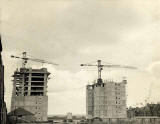
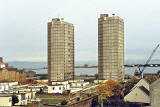
Leith Flats Grampian and Cairngorm Houses "Does anyone have any pictures of Grampian and Cairngorm Houses. There is a photo of the flats already on the EdinPhoto web site. In fact here are a few photos of the flats on the site. - Peter Stubbs However, I wondered if anyone actually lived there and took pictures of the inside (stairwells, lifts etc)." BBC Drama "The flats featured in a BBC drama 'The Advocate' and I wrote a story about these flats, as I grew up around the area. When the flats were empty and the council were setting a date for demolition, I remember going inside the stairwells and climbing the stairs. These were in order of letter: A,B,C and so on. Drugs "I remember seeing needles and tin foil everywhere. It inspired me to write a story about it, going back the grim but great 1980s, when Edinburgh was slate grey and these flats were many people's homes. I'd love to see more pictures if anyone has any." Vicki, Edinburgh: Message posted in EdinPhoto Guestbook, October 16, 2012 |
|
Recollections 4. Heather Lane Aldershot, Hampshire, England |
|
Thank you to Heather Lane who wrote about growing up in Leith. Heather says she hopes I might be able to give her more information about Tennant Street. Heather wrote: |
|
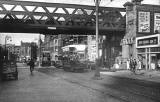
Leith Recollections Home "I believe I was born in Tenant Street, towards the bottom of Lieth Walk." Tennent Street still exists, but it is now in an area of small businesses, all the housing having been demolished. It lies between Bonnington Road and Leith Walk.** "There used to be a bridge over Leith Walk. I don't know why I remember this bridge." Here is a photograph of the bridge, taken in the mid-1950s. It was demolished long ago, but I read recently that there are plans to build another to take a new footpath and cycle track across Leith Walk, as part of a route to Portobello.** Bridge over Leith Walk "I grew up there in the early 1970s with my parents Tam & Tessa Oliver. I remember living in a basement flat. Our next door neighbour was an old man named Arthur. He had a bed-ridden wife who I used to go sit with after school." Family "I remember I went to Sunday School at Pilrig Church. I used to walk to my Nana's home. I walked past the church, then across Leith Walk. There was a police box at the end of her road. I'm sure there was also a pub there with a shoogy bar, were I could find her. What was a "shoogy bar"? ** I think she lived at Albert Street, but I may be wrong. Yes, Albert Street was about there.** I only ever knew her as Nana, but I believe she remarried and became Black. She died in a home fire around 1973. My dads older brother and sister, Billy and Norma Oliver, also lived nearby." School "I think I went first to Dr Bell's School, next door to the swimming baths, then to Bonnington Primary School. From were I lived, I would walk through a big park and under the bridge to get to school. That would have been Pilrig Park.** Great Junction st is a big memory for me. When I was very young, my mum worked in a fruit shop there. On my lunch break from school my friend and I would sneak out and go see her." Memories "It's crazy but great, after starting to write you this, it's as if some of the memories are just coming back. It would still be great if you could fill in some of the gaps. I've lived in England for a long time now, but my son and I have booked a holiday for for five days in Edinburgh next February. It would be good if I could take him on a tour and know what I'm talking about." Heather Lane, Aldershot, Hampshire, England: November 18, 2012 ** = comments added by Peter Stubbs, Edinburgh: November 19, 2012 |
|
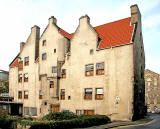
Leith Today Heather: Some parts of Leith, especially around the Docks will have changed a lot since you grew up in Leith in the 1970s. You'll now find new Scottish Government Offices, a hotel, some expensive new apartments and a casino, all in the docks area - and Ocean Terminal Shopping & Cinema Complex has been built where the Henry Robb shipyard used to be. Scottish Government Offices Ocean Terminal Some of the old housing and shops have been demolished and the old Kirkgate shopping street has been replaced by a small newer shopping centre, offices and flats at the foot of Leith Walk. Other buildings, including some of the old warehouses and Lamb's House, have been restored. Lamb's House Some of the old pubs around The Shore have been given a new lease of life, and have been joined by several new restaurants, including one on board a boat moored in the Water of Leith beside The Shore. Ocean Mist (Restaurant) So, tourists, rather than sailors, can now be found wandering around Leith in the evening!. Peter Stubbs, Edinburgh: November 19, 2012 |



|
Recollections 5. Joy Mikulandra (née Wyatt) Australia |
|
Thank you to Joy Mikulandra for writing about her visits to Goldberg's store in Edinburgh with her Mum. Joy went on to tell more about her Mum who used to live in Leith. Joy wrote: |
|
Mum Agnes Wyatt (née Agnes Forbes McKenzie) "Mum grew up in Leith and went to Yardheads Primary School, probably from 1926 to 1933. Her parents Henry and Isobel Mckenzie (née Forbes) and sister Minnie Henderson are buried in Seafield Cemetery as is she. Sadly, Mum passed away in 2009 from dementia, so a lot of her history is missing. I know that: - She sang in swing band in the 1940s. I found this out at the funeral! - She suffered shellshock when she was in the WAAF in Pocklington, England. The ammunitions factory where she was working took a direct hit. She was Aircraft Woman 2nd Class. - She worked in a bonded warehouse, Ross Bros, 73 Excise St Leith from 1943 to 1947. - She emigrated to Australia, around 1959, then married and had my sister and me. If anybody remembers my Mum, or has any stories about,her I'd love to hear from them. Joy Mikulandra (née Wyatt): February 5, 2013 |
|
Recollections 6. Gordon Davie Abbeyhill, Edinburgh |
|
Thank you to Gordon Davie who wrote: |
|
Question Leith Flats "I have a question for your Leith readers. My auntie used to live in one of the tower blocks at the bottom of Prince Regent Street which were built in the early 1960s. She was there for about twenty years but eventually managed to get another house just off Lindsay Road, much nearer the ground! New Names "After my auntie moved out, the tower blocks were extensively renovated (though I'm sure there's no connection between these events!) and were renamed: - Citadel Court (Citadel was a local landmark) and - Persevere Court ('Persevere' is, of course, Leith's motto)" Old Names "However, when she lived there the buildings were named: - John Russell Court and - Thomas Frazer Court. My question is - who were these two gentlemen? I assume they had a Leith connection but I've been unable to find any reference to them. Your readers have come up trumps in the past in identifying the location of old photos and the like so I'm hoping somebody will be able to answer this!" Gordon Davie, Abbeyhill, Edinburgh: June 3, 2013 |
|
Recollections 7. Peter Stubbs Edinburgh |
|
Reply Leith Flats Hi Gordon: I don't have a full answer about the old names of the flats in Leith that you ask about. However I did find the brief comment below on a Flickr web page: "Persevere Court and it's twin Citadel Court were built as John Russell Court and Thomas Fraser Court respectively from 1961 as part of the Leith Citadel redevelopment. Russell was an author of Leith and Fraser was his schoolmaster." Peter Stubbs, Edinburgh: June 3, 2013 |
|
Recollections 8. Malcolm J B Finlayson Arbroath, Argus, Scotland |
|
Thank you to Malcolm for sending me a topical story today, Palm Sunday, 2014. Malcolm wrote: |
|
Sunday School Teacher "My mother was a teenage Sunday School teacher in the late- 1920s in a Leith church. It was Palm Sunday, and my mother was telling her class the story of Jesus sending two disciples ahead to Jerusalem, advising them to untether, and take an ass, and advising them that if anyone should enquire of where they were taking the ass, "Wherefore art thou taking the ass?", they should say that they were taking it for the Master. Mary, a little girl, from a poor background, was crayoning on a piece of paper, apparently oblivious the the story that was being told. Slightly irritated, and sure that she could catch Mary out, my mother asked her what the man would say, on discovering the disciples taking the ass. Without looking up, or hesitating to stop crayoning, Mary replied: "Hey You! Whaur do ya think yer gaun wi' that dunkey?" Bless her! Mary had been listening after all, and responded in words to which she was accustomed. My mother remembered that fond amusement for the rest of her life." Malcolm J B Finlayson, Arbroath, Angus, Scotland: April 13, 2014. |
|
Recollections 9. Scott Rendall |
|
Thank you to Scott Rendall who wrote: |
|
8 Coburg Street William Rendall "I'm Scott Rendall. My late father, William Rendall, resident of No.8 Coburg Street played for Broughton Star, many years ago. He would have been 85 years old if alive now. I'd love to know if anyone remembers him." Scott Rendall: December 24 2015 |
|
Reply to Scott Rendall? If you remember William Rendall, and would like to send a message to Scott, please email me to let me know, then I'll pass on his email address to you Thank you. Peter Stubbs, Edinburgh: 24 December 2015 |