Recollections Training at Leith Nautical College |
|
Recollections |
||
|
1. |
Walter Lyle Hume |
Enrolment Studies Life Boat Drill Air Raid Fire Watching Live Ammunition Training SMT Buses |
|
2. |
Bob
Henderson |
Amateur Radio Licence |
|
3. |
David
Malcolm |
1951 Students |
|
4. |
Frank Ferri |
TS Dolphin |
|
5. |
Margaret Duff (née McKay) |
Leith |
|
6. |
Jack Munro |
Former Students - 1950s |
|
6. Reply 1. |
Les Black |
Buster Black |
|
6. Reply 2. |
Peter Logan |
Buster Black |
|
7. |
Dorothy
Addison |
Former Student - 1952: George Johnston |
|
8. |
Ian M
Malcolm |
Former Student - 1947-48 - The College |
|
9. |
John Leith |
TS Dolphin - 1967 |
|
10. |
Polly
McCallum |
Info about Jim Dunkley |
|
11. |
Arthur Rafferty |
|
|
Recollections 1. Walter Lyle Hume Cowes, Isle of Wight |
Thank you to Walter Lyle Hume, now living in Cowes, Isle of Wight, England, for sending me his recollections of training at Leith Nautical College to become a Merchant Navy Apprentice, known by some shipping lines as a Merchant Navy Cadet. Here are some extracts from Walter's recollections: |
|
Enrolment "During the early part of the 1939-45 War, I went scurrying, along with two other friends, to enroll at Leith Nautical College, at the Citadel Dock Gates in Commercial Street. We went through the large glazed oak portals into a busy tiled entrance halls, adorned with beautiful ship models, some of them cut away to show the method of construction which we were to learn a lot about later. There were problems in obtaining the nautical books due to the acute wartime shortages. Then we had to pay five shillings (25p) for the obligatory, all-important Board of Trade 'Eye-sight' test." Studies "Within a very short time it became obvious that this type of work was so vastly different from day school, so recently and eagerly left behind. Instead of being treated as school pupils, we were now expected to be and behave as adults. This was brought to the fore at 10 o'clock coffee break (or in college/merchant navy parlance 'smoke oh'). A quick dash outside for those who wished to and could afford it." Life Boat Drill "Friday afternoon became a form of compulsory PE games, except the sports were confined to 'Lifeboat' drill. The college lifeboat was situated at the edge of the dockside wall at West Old Dock." Air Raid Fire Watching "We were always on the look-out to enhance our limited expendable income, even a bit of roof top Air Raid fire watching Most firms were obliged to have employees carry out these duties, for which the government paid an allowance to the individual of 2/6 (12.5p) per night plus camp bed. We were usually selected to be used as stand-in watchers for those having a night-off." Live Ammunition Training "We learnt how to strip a Lewis gun down to the last nut and bolt, then put it all together again. In the second part of the course we were assigned to 'live ammunition' gunnery practise, which was conducted at a quiet seaside sand dune range some fifteen miles from our base. Lunch there was a small bottle of beer and a spam sandwich." "We travelled there by SMT bus, complete with trailer! This transpired to be a gas generator to run the engine. The gas storage bag, rather like a mini-barrage balloon was fitted on top where normally external luggage would have been stowed. The trailer, very similar to a small fire pump had a mini-boiler, the furnace being stoked with anthracite coal to make the propellant gas. The solid fuel was stowed in the rear boot of the bus." Walter Lyle Hume, Cowes, Isle of Wight, England. May 25, 2006 |
|
Recollections 2. Bob Henderson Burdiehouse, Edinburgh |
|
Thank you to Bob Henderson, Burdiehouse, Edinburgh who wrote: |
|
Amateur Radio Licence "It's good to see the shore side of Commercial Street, looking not to different from my memories of it. I studied at the old Nautical College for a year of night classes to get my Amateur Radio Licence 36 years ago, and worked in the Leith area for about 17 years with NT Aitken, builders." Bob Henderson, Burdiehouse, Edinburgh: December 21, 2007 |
|
Recollections 3. David Malcolm New Zealand |
|
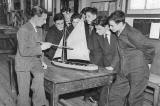
Thank you to David Malcolm for sending photographs to me, including the one above. David left Edinburgh in 1956 and is now living in North Island, New Zealand. David wrote: 1951 Students "I hope my photos may bring back some happy memories. I am seated, second left in this photo. These students at Leith Nautical College in 1951 are in the pre-sea training course for youths aiming to join shipping companies as Apprentices. The course was for a full year which included practical seamanship and navigation theory plus related subjects. Successful completion of the course led to a six months reduction to the four year apprenticeship. David Malcolm, North Island, New Zealand: January 18, 2008 |
|
Students - 1951 |
|
Recollections 4. Frank Ferri Newhaven, Edinburgh |
Between 1939 and 1958, Frank lived in Ballantyne Road, Leith, opposite the State Cinema. Frank wrote: |
|
TS Dolphin "I remember when graduating from the TS Dolphin at Leith Nautical College, the captain saying to us: 'Now remember guys, you'll be travelling all over the world and people will ask you: "Where are you fro?" Never ever say Edinburgh out of convenient expediency. ALWAYS say LEITH and let them work it out.' I've made that custom and practice ever since and promote LEITH a every opportunity." Frank Ferri, Newhaven, Edinburgh (formerly Newhaven, Leith!): April 12, 2008 |
|
Recollections 5. Margaret Duff (née McKay) Near Oban, Argyll, Scotland |
Thank you to Margaret Duff (née McKay), now living near Oban, Argyll, Scotland, for leaving a message in the EdinPhoto guest book. Margaret wrote: |
|
Leith "I was interested to read the piece by Walter Lyle Hume (1. above) concerning Leith Nautical College from 1939-1945. My Father, Donald Forbes McKay, (ex Ben Line) taught the Merchant Navy Cadets during those years before moving to the Navigation School in Aberdeen. He was also Scotland's first Extra Master to gain his certificate after the war. We used to travel by train every day; he to Leith along with Captain Tait, and my brother and I to Trinity Academy where we went to the Primary school. My husband is a Member of the Trinity House of Leith, the Master being Captain Magnus Poulson." Margaret Duff, near Oban, Argyll, Scotland: April 14, 2008 |
|
Recollections 6. Jack Munro Newcraighall, Edinburgh |
|
Thank you to Jack Munro for leaving a message in the EdinPhoto guestbook. Jack wrote: |
|
Former Students - 1950s "I was fortunate to get my Second Class ticket at Leith Nautical in the 1950s, in the Radio Section. I'm trying to locate details of some of the former students from that period. They are: - A Bogie - H Watson - Butcher I came back and get my First Class Ticket. Some fellows in same class then were: - Buster Black - Peter Logan - Bill Scott"
Jack Munro, Newcraighall,
Edinburgh: |
|
If you'd like to send a reply to Jack, please email me, then I'll pass on your message to him. Thank you. Peter Stubbs: December 10, 2009 |
|
Recollections 6. Reply 1. Les Black Melbourne, Victoria, Australia |
|
Today, I received the first reply to Recollections 6 that Jack Munro posted above in 2009. The reply came from Les Black who wrote: |
|
Buster Black
"I am
gobsmacked! Les Black, Melbourne, Victoria, Australia: July 4, 2013 |
|
Les and Jackie It must have been a surprise to Les to read the message above. It's probably about 60 years since Les was in the same class as Jackie at Leith Nautical College. I've now forwarded the latest email address that I have for Jack to Les. I hope they will be able to get in touch with each other. Peter Stubbs, Edinburgh: July 4, 2013 |
|
Recollections 6. Reply 2. Peter Logan Haslington, near Crewe, Cheshire, England |
|
I've now received a second message for Jack Munro. It comes from Peter Logan who wrote: |
|
Family in Leith "Hi Jack: I've just received am email from Buster Black giving me details of the EdinPhoto web site mentioning yourself and other Leith Nautical attendees. Buster and I regularly contact one another through emails. I now live with my wife in Haslington nr Crewe and have memories of the College. Would you believe that my youngest daughter and her husband lived in a flat at the other end of the building adjoining the College. They still live in Leith. Happy memories!" Peter Logan, Haslington, near Crewe, Cheshire, England: July 28, 2013 |
|
Recollections 7. Dorothy Addison Tsawwassen, British Columbia, Canada |
|
Dorothy Addison left this message in the EdinPhoto guest book, hoping to be able to contact a former student from Leith Nautical College: |
|
Former Student George Johnston - 1952 "I am trying to locate a fellow called George Johnston. He lived at 26 Dalkeith Street, Joppa, Edinburgh. He joined the Ben Line after studying at Leith Nautical College in 1952 and served with them for a few years. He would be around 75 years of age today. I have located his brother Tommy Johnston. (There was also a brother called Roy who has passed away.) Tommy has also lost touch with his brother George, and could not help me. My maiden name was Dorothy Jenkins. I am also from Joppa.
Dorothy Jenkins, Tsawwassen, British Columbia, Canada |
|
Reply? If you think you might be able to help Dorothy to contact George, please email me, then I'll pass on your message to her. Thank you. Peter Stubbs: January 5, 2009 |
|
Recollections 8. Ian M Malcolm St Andrews, Fife, Scotland |
|
Thank you to Ian M Malcolm who came from Dundee to study at Leith Nautical College for a year in 1947-48. Ian wrote: |
|
1947-8 The College "I was a Radio Officer in the Merchant Navy and wanted to upgrade to 1st Class PMG. Dundee Wireless College had closed, so I came to Leith Nautical College in Commercial Street in 1947 to study for a year. The fee for the year was a nominal £5, no matter how long I attended the college. Ironically, the fee to sit the exam was exactly double that amount. The college had departments in Navigation, Engineering and- Radio. The Radio Department had a lecture room, a Morse room and a room containing the very latest of marine equipment. Students These are some of the students that I remember: - Syd Campbell - Ducat - George Mein "There were two classes at the college, one studying for the 2nd Class PMG and the other for the 1st Class. All the 2nd Class students were ex-servicemen. The students had some interesting stories to tell, but none more so than Bill Walker of Edinburgh. Bill, nicknamed 'The Chief', was a product of Edinburgh's Royal High School. His writing was more like hen's scratchings. He was a cheerful chap, and had been at sea throughout the war. He was a prisoner on the Altmark after his ship was sunk by the Admiral Graf Spee. In defiance of international law, HMS Cossack intercepted the Altmark in Norwegian territorial waters and brought her prisoners to Leith. This event occurred in February 1940 and, being a local boy of only 16, Bill made the lead story in the local paper." Ian M Malcolm: St Andrews, Fife, Scotland: January 24, 2010 |
|
More Recollections 1947-48. Ian has also written about digs, cinemas, dance halls and other aspects of his year in Edinburgh. Here are links to these recollections. |
|
Recollections 9. John Leith New Zealand |
|
Thank you to John Leith who wrote: |
|
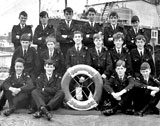
TS Dolphin "This old photo is of myself whilst doing my training on TS Dolphin at Leith in 1967. I am on the back row, 2nd left. 1967 It would be great to hear from any of my old class mates." John Leith, New Zealand: August 18+19, 2012 |
|
Please click on the thumbnail image above to enlarge it, and to see photos of HMS Dolphin and Leith Nautical College: |
|
Reply to John If you remember John and would like to send a reply to him, please email me, then I'll pass on his email address to you. Peter Stubbs: October 13, 2012 |
|
Recollections 9. Reply 1. Henry McKay |
|
William Ferguson for sending me this message on behalf of Henry McKay: |
|
TS Dolphin "I was on TS Dolphin in 1967. I am in the second tier, very left, in this photo. 1967 I remember John Leith, Davy Sturrock and a few others. Henry McKay.: 28 January 2015 |
|
Recollections 10. Polly McCallum Australia |
|
Polly McCallum replied to Ian M Malcolm's Recollections 8 above Polly wrote |
|
Jim Dunkley "Ian mentions knowing my father, Jim Dunkley. Dad travelled from New Zealand to attend Leith Nautical College and met my Mother when staying in digs in Broughton Street. Mum, dad and older brother travelled to Fiji where my father had a position with NZ Civil Aviation. My twin brother and I were born there. I grew up at the Top of Leith walk and attended local schools. Can you please advise." Polly McCallum, Australia: July 4, 2014 |
|
Recollections 11. Roberta Murphy (née Rafferty USA |
|
Roberta Murphy wrote: |
|
Arthur Rafferty "My brother, Arthur Rafferty was born in 1939. - He attended St. Ignatius Primary School - He continued his education at St. Anthony's Secondary School. - In 1955, he was a student at Leith Nautical School, training for his sea-going career. Unfortunately, he was killed on December 30, 1955 during his first trip to South America. I was twelve at the time. It would be wonderful if someone remembered him and contacted me." Roberta Murphy (née Rafferty): July 12, 2014 |
|
Reply to Roberta? If you remember Arthur Rafferty and would like to send a message to Roberta, please email me to let me know, than I'll pass on Roberta's email address to you. Peter Stubbs, Edinburgh: July 13. 2014 |