|
Links to Other Pages
|
| ||||||||||||||||||||
|
|
|
|
Reflex Camera Advice for Photographers in Edinburgh Around 1900 |
|
For Amateur Photographers From around the 1890s onwards, amateur photography reached the masses. New photographic Societies were created and the photographic journals gave advice on new equipment. |
|
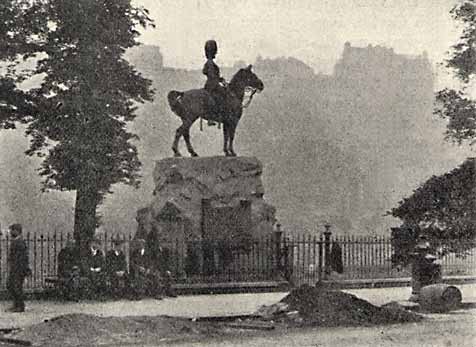
The Reflex Camera The British Journal of Photography, in 1911, included an article entitled: The Range of Power in a Reflex Camera The article was illustrated by several photos taken in and around Edinburgh, including: 1. Highland pipers entering Edinburgh Castle, illustrating that the reflex camera enabled the focusing to be done and photo to be taken in a more casual manner than was possible with earlier equipment. 2. a photo of the Heart of Midlothian, a pattern set into the pavement in the Royal Mile, Edinburgh. This was used to demonstrate the use of the focusing screen on a reflex camera to achieve accurate focus. 3. a photo of the recently erected Royal Scots Greys statue in Princes Street Gardens. This photo illustrated the use of a wide aperture of f4.5 on a dull day, in order to keep the main subject in sharp focus against the backdrop of Edinburgh Castle. The Royal Scots Greys Statue - Princes Street Gardens
© Reproduced by courtesy of Edinburgh Photographic Society This
statue commemorates the Royal Scots Greys who left Edinburgh in 1899 to
fight 4. A photograph of RL Stevenson's cottage at Swanston, near Edinburgh, was taken over a high hedge. The journal described this photo as being "one of several photos made by holding the camera at arms' length upside down above the head, in which position the view may be seen and focused, and exposure made with almost as much readiness, though with somewhat more fatigue, as in the ordinary position. In order that the reflex should be used in this way, it is essential that the mirror should not be of a type which falls again automatically and by its own weight after exposure." |
|
Links to Other Pages
|
Let the cursor hover over any of the buttons above and it will display further details.
LINKS: All underlined words and pictures on this site are links. Please click on any of them..
| ||||||||||||||||||||