|
Training Ship at Old Dock Leith TS Dolphin |
TS Dolphin
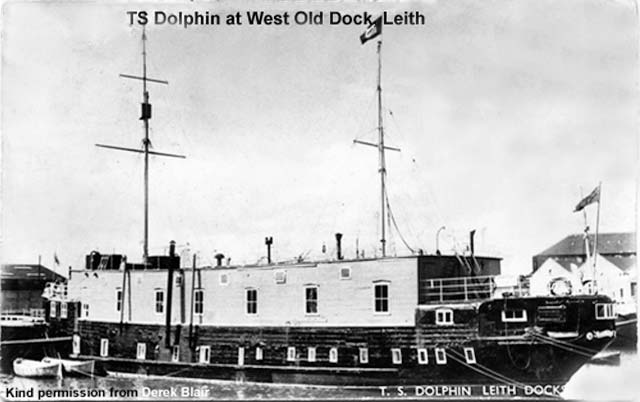
© Reproduced with acknowledgement to Derek Blair, Australia, formerly an officer with Ben Line in Leith
|
TS Dolphin |
|
Training Ship at Leith Between 1944 and 1977, TS Dolphin acted as a merchant navy training ship, based at Leith Docks, Edinburgh, training 4,000 boys, including Derek Blair, now living in Australia, who provided the photograph above. Thank you, Derek. Thank you, also, to John D Stevenson Edinburgh, for provided the comprehensive notes, below. John wrote: |
|
Construction "DOLPHIN was the fifteenth ship to bear the name of “HMS Dolphin” and was built by the Middlesbrough firm of Dixon & Co. Ltd., and was launched on 9th December, 1882. The hull was planked with four inch mahogany covered by a two inch layer of teak, with the hull up to the water line, sheathed with heavy gauge copper. The main deck forward was ten inches thick and the ship was reinforced, both fore and aft, ready to take large calibre guns. She was a three-masted auxiliary barque, of 925 tons, fitted with a horizontal compound “Back acting” steam engine. Her normal crew numbered 113" |
|
Early Sailings "The ship was commissioned at Sheerness in 1884 and was first attached to the Mediterranean Squadron. In 1885 a landing party from the ship's crew formed part of a naval brigade landed at Suakin in the Sudan. In March 1885 she saw active service in Egypt, India and Australia, and fought at the battle of Tofrik. She saw further action in 1888 dealing with the remnants of the slave trade. In 1896 she was paid off at Sheerness. Later her engines were removed and she became a sea-going sail training ship, stationed at Portland taking boys on four month sail training cruises." |
|
Portsmouth "In 1907, the ship was de-rigged and transferred to Portsmouth. In the early years of the submarine branch of the Navy, Dolphin was used as a depot ship along with H.M.S. Mercury, later moving to Gosport. Dolphin remained in this role as the first submarine depot ship until 1924 when she was decommissioned, giving her name to HMS Dolphin Submarine base at Gosport . In 1925 Dolphin was bought by Lieutenant Commander J. M. Robertson, a Glasgow ship-owner and Sir Donald Pollock. . Their plan was to convert the ship into a nautical museum." |
|
Arrival at Leith "The old vessel was towed from Portsmouth to Leith but when entering the Firth of Forth the ship encountered extremely heavy weather and took on board a large amount of water. The next day the tug crew decided Dolphin was slowly sinking took the decision, for safety sake, to beach her off Fisherrow. There she lay for nearly a year before being taken to Leith dry dock for repairs, then Rosyth for refitting. In 1928, she was berthed at the West Old Dock, Leith." |
|
Training Ship at Leith "In 1944, Dolphin changed careers again, to become a Merchant Navy Training Ship. Captain Salvesen, Mr Tom McPhail and Mr J. J. Robertson agreed with Leith Nautical College that she should become a a pre-training sea school for cadets and deck boys. It was then she became "TRAINING SHIP (TS) DOLPHIN" Captain Adam Tait, a native of Shetland, and a Master Mariner took " command" at this time. TS Dolphin was eventually presented, by Sir Donald Pollock, to the "TS Dolphin Training Ship Society" The ship to be leased to to Leith Nautical College. The welfare of the boys, the social life of the ship and the organising of evening classes remained with the Society. Up to fifty boys had residential accommodation on Dolphin. 80 to 90 boys were at any one time being taught , This was made up of Deck Boys, Catering Boys and Cadets. In 1950 the college opened a class for ship's cooks; boys who trained sat the Ships' Cooks and Catering Certificates. The department was run under the guidance of the Atholl Crescent School of Domestic Science." |
|
The End "The need for this type of ship declined, and on July 4, 1977, when West Old Dock was scheduled to be filled in, she was towed away from the dock. She was beached later that day, on a spring tide, near to Bo’ness, to be burned out where she lay It was ironic that her fate was decided in order to salvage her copper cladding that had kept her hull in good condition for almost a century. |
|
Acknowledgements 1. Thank you to John D Stevenson, Edinburgh for the notes above, based on his research from various sources - May 25, 2007. 2. Thank you, also to Eric Gold, East London for telling me that the TS Dolphin section of the All at Sea web site gives historical information about the ship and photos of some of the boys who trained on her at Leith. - May 22, 2007 |
|
Reply 1. Bill Gunn Samoa |
|
Bill Gunn wrote: |
|
HMS Dolphin "I am an Australian currently living and working in Samoa. I have collected any prints, books and other memorabilia about Samoa over the past 30 odd years. Among the many newspaper clippings is an engraving of a sailor at the corner of a street in the capital city of Apia. He is captioned as being 'Gunner Gunn of HMS Dolphin'. The newspaper from memory is dated around 1894. From the EdinPhoto web site, I see that there was an HMS Dolphin which travelled to many parts of the world including Australia. It may well have come through Samoa as well." Question "I am particularly interested in researching this vessel mainly because I too am a Gunn, originally from Scotland, UK, Australia and now Samoa. It seems that I was not the first Gunn to arrive on these shores! Can you assist me? I'd like to find information about the crews of such vessels, then try to trace the family histories to see if I might be related to Gunner Gunn." Bill Gunn, Samoa: October 26, 2012 |
|
Reply Hi Bill: I don't have any information about the crews myself. I'll make some enquiries and will let you know if I discover anything. Peter Stubbs, Edinburgh: October 26, 2012 |
|
Update I've now received Reply 2 (below) from John D Stevenson. Peter Stubbs, Edinburgh: October 26, 2012, 10pm |
|
Reply 2. John D Stevenson Trinity, Edinburgh |
|
Thank you to John D Stevenson who wrote: |
|
HMS Dolphin Launched 1882 "T.S. Dolphin (the training ship at Leith) was built at Middlesburgh and was launched in 1882, the fifteenth ship to bear the name HMS Dolphin." Built 1750 / 1751 "HMS Dolphin which visited Samoa in 1767 was a different ship, a 24 gun 'sixth rate frigate' built at Woolwich Dockyard 1750/51. She was used as a survey ship from 1764 and made two circumnavigations of the world under the successive commands of John Byron and Samuel Wallis . She was the first ship to circumnavigate the world twice. On 17th June 1767 Captain Samuel Wallis RN , Commander of HMS Dolphin, raised the British flag in Samoa. The vessel remained in service until she was 'paid off' in September 1776 and finally broken up in early 1777 John D Stevenson: October 26, 2012, 8.30pm |
|
I asked John if he could suggest where any details might be found of crews of early ships visiting Samoa. John replied |
|
Research "I don't think there is much chance of finding crew lists. However, I have used the following sources for early shipping information in the South Pacific: - State Library of New South Wales - Maritime Museum of San Diego" John D Stevenson: October 26, 2012, 10.30pm |
|
Reply 3. Gill King West Wickham, Kent, England |
|
Gill King wrote: |
|
Uniform "I recently acquired an Original Sailors uniform with 'HMS Dolphin' on the hat. The name inside the trousers is RC Moxham. Question "Do you know how I can find out more about this crew member?" Gill King, West Wickham, Kent, England: August 4, 2014 |
|
Reply to Gill King I don't have any suggestions as to the best way fpr Gill to pursue her interest in the crew member, RC Moxham. If you have any suggestions for her, please email me to let me know, then I'll pass on her email address to you so that you can try to contact her. Thank you. Peter Stubbs, Edinburgh: August 4, 2014 |