|
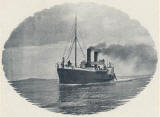
Paddle Steamer "William Muir" 'Granton to Burntisland' |
|
|
1879 The iron hulled paddle steamer "William Muir" was built at the yard of J. Key & Son, Kinghorn, 1879, for North British Railway to provide a passenger service across the Firth of Forth from Granton Harbour to Burntisland in Fife. The ferry service was operated by "William Muir" and "John Sterling". These were named after the Chairman and a senior director of the North British Railway. Each of these ferries could carry 950 passengers - and a number of horses! |
|
|
1910s The vessel was completely refurbished in 1910. It was given a new engine and boilers and its two funnels being removed and replaced by a single larger funnel. It was, requisitioned by the Admiralty for minesweeping duties in 1917 at Sheerness, until released from service 1919. Her then Master, Captain Clark remained with the ship during her war service. |
|
|
Withdrawal - 1937 The North British Railway Company was taken over in 1927 by the London & North Eastern Railway. "William Muir" served continuously until withdrawn from service in 1937. "William Muir" was quietly towed to the ship breakers yard at Charlestown-on-Forth, after having travelled over 800,000 miles during her 58 years in commission: 'William Muir' Deckhouse When "William Muir" was broken up, her deckhouse was preserved and was built into the clubhouse of the sailing club at Brucehaven, near Limekilns.**.
|
|
|
Newspaper Report A newspaper report in 1937 gave an account of the "William Muir" shortly before it came to the end of its 58 years' service. Here is an extract from the report: The Circus "One of the heaviest traffics with which the "William Muir" has been associated was the transport from Granton to Burntisland of Lord George Sanger's Circus and Menagerie one night in 1889, when she and her sister ship, "John Stirling", shipped over 500 horses, camels, dromedaries, elephants and other animals and 50 caravans. Embarkation began at 10 o'clock and by 4 o'clock the next morning, the whole of this vast consignment was safely landed at the other side. Some difficulty was experienced in the loading of the large caravans, and the services of 'Jumbo', the largest elephant, were enlisted more than once to move these vehicles across the pier."
This report was found in the Press Cuttings
at Kirkcaldy Library [PC 3866].
|
|
|
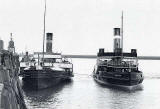
Replacement The 'William Muir' operated on the ferry service for the last time on 3 March 1937. She was replaced by 'The Snowdrop', built in 1910, which had previously served between Liverpool and New Brighton. When it came to the Firth of Forth, it was given a new name: 'Thane of Fife'" - the same name as one of the ferries built for the Granton-Burntisland ferry in 1847 and transferred to Queensferry in the 1850s. Here is a photo of 'William Muir' and 'Thane of Fife' taken at Granton Harbour on 3 March 1937. The following day, 'William Muir' was taken to the shipbreakers' yard at Charlestown in Fife. |
|
|
Poem Here is the first of three verses in a poem by Nan I D MacDonald's: 'The William Muir' "For nearly three-score years she plied Across the restless Firth, And oftentimes her prow and stern Have echoed to our mirth, The wind and waves have scarred her sides And made her insecure, And soon the `breakers` yard will claim, The sturdy William Muir." Nan MacDonald |
|
|
[With acknowledgement to Walter Lyle Hume for his research and providing the "William Muir" details above] |
|
Background 1. Janet White |
|
Thank you to Janet White who wrote: |
|
Names of Ferries William Muir "I am great-great-granddaughter of William Muir (born Altona, Germany, 1801; died Edinburgh, 1880). He was owner of the distillery called 'William Muir, Bond 9', in Leith, now owned by Whyte & Mackay
- He was Vice-Consul for
Portugal. - He owned many North British Railway shares. I believe that the Granton-Burntisland ferry was owned by the railway, and and that the railway named one of its ferries, 'William Muir', after one of its larger stock holders." Janet Cowan "Another ship, the 'Janet Cowan' was named after William Muir's mother." Janet White: July 5, 2010 |
|
Background 2. Peter Stubbs Edinburgh |
|
'William Muir' Brucehaven Clubhouse Demolished Today, I contacted one of the members of The Forth Cruising Club, the club that's based at Buckhaven Harbour. I had hoped that it would be possible for me to visit their clubhouse and take some photos of the 'William Muir' deckhouse. Unfortunately, I learnt that the club's old clubhouse was demolished some time before 1998. I was not able to discover whether or not the 'William Muir' deckhouse has survived, or where it is now if it has survived. Peter Stubbs, Edinburgh: June 8, 2012 |
|
Update William Muir Deckhouse Perhaps the deckhouse of the William Muir has not been lost after all. I spoke to John Stevenson, ship researcher, Trinity Edinburgh this week. He told me that he heard of somebody who has seen the deckhouse within the last couple of years. I'll try to discover more about it, and will add what I find to this page. Peter Stubbs, Edinburgh: July 4, 2013 |
|
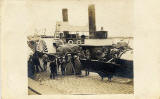
Granton-Burntisland ferry 1850-1890 |
Granton-Burntisland ferries |