|
Edinburgh Recollections
Fleshmarket Close
Linking Cockburn Street and Market Street, Old Town, Edinburgh |
|
Question |
Pauline Cairns-Speitel
Old Town, Edinburgh
|
- The Plowt
|
|
Answer 1. |
Bob Henderson
Burdiehouse, Edinburgh
|
- To Plowter
|
|
Answer 2. |
Stephen McMahon
Edinburgh
|
- Fruit Market
- Pet Shop
- The Scotsman
|
|
Answer 3. |
Douglas Beath
Tasmania, Australia
|
-
To Plowter
- Pet Shop
|
|
Answer 4. |
Yvonne Cain
New South Wales, Australia
|
- Plowt
|
|
Answer 5. |
Pauline Cairns-Speitel
Old Town, Edinburgh
|
- Dictionaries
|
|
Answer
6. |
Bob Henderson
Burdiehouse, Edinburgh
|
- To Plowter
|
|
Answer
7. |
Bryan Gourlay
Biggar, Lanarkshire, Scotland
|
- Change of Use
|
|
Answer
8. |
Joyce Messer
North Island, New Zealand |
- Plowt
|
|
Answer
9. |
Bob Wyllie
Brussels, Belgium |
- Plowt
- Pet Shops
|
|
Answer
10. |
Eric Gold
East London, England |
- Pet Shop
|
|
Question
1.
Pauline Cairns-Speitel
Old Town, Edinburgh |
|
Pauline Cairns-Speitel wrote: |
|
'The Plowt'
"I am an Editor who works at Scottish Language
Dictionaries.
I have come across the 'The Plowt' as a
nickname for Fleshmarket Close in Edinburgh. I had never heard of this
before and, as an Edinburger who thought she knew her city, I was
surprised until I spoke to another (not so old) resident of Edinburgh who
knew it as Fleshmarket Close where one could go to buy rabbits.
Fleshmarket Close
©
Here is another reference to it:
|
'The Plowt'
"Edinburgh's old poultry-market in
Fleshmarket-close, which old-timers remember as the Plowt. . . .
Two boys look at rabbits in a corner of the
Plowt, the poultry market in Fleshmarket-close."
Daily Express of 9 January 1957
|
Fleshmarket Close, as I understood it, led to
the Fleshmarket in Market Street, but clearly there was some trade going
on in smaller animals actually in the close itself." |
|
Question
"Can you, or any of your correspondents, cast
any light on this for me?" |
|
Pauline Cairns-Speitel, Scottish Language
Dictionaries, 27 George Square, Edin.: August 11, 2008 |
|
Answer?
If you'd have any comments for Pauline,
please email me, then I'll pass your message on her.
Thank you. - Peter
Stubbs: July 17 2008 |
|
Answer
1.
Bob Henderson
Burdiehouse, Edinburgh |
|
Thank you to Bob Henderson who replied: |
|
To Plowter
"I don't know about The Plowt, but there is
another word 'to plowter' which I have always understood to mean walking
about in the mud or similar.
Maybe the old Flesh market close was not very
pleasant to walk down.".
Bob Henderson: Burdiehouse, Edinburgh, August 11,
2008 |
|
Answer
2.
Stephen McMahon
Edinburgh |
|
Thank you to Stephen McMahon who replied: |
|
Fruit Market
"Sadly, I have no direct input for Pauline.
However, I spent a lot of my childhood in the area - my father worked in
the fruit and vegetable retail and wholesale trade and I accompanied him a
lot to Market Street when it was still the site of the fruit market."
|
|
Pet Shop
"The only rabbits I saw on Fleshmarket Close
in the 1960s and early 1970s were in a small pet shop situated a few yards
down from Cockburn Street on the close. Other than that, the only
businesses located there were pubs."
|
|
The Scotsman
"The Close also housed the staff entrance to
the Scotsman/Evening News when it was still actually printed there. Again,
I remember as a boy being sent to the loading bay of the Scotsman to buy
the Evening News literally hot off the press - the paper was still
warm….." |
|
Stephen McMahon, Edinburgh, August 12, 2008 |
|
Answer
3.
Douglas Beath
Tasmania, Australia |
|
Thank you to Douglas Beath who replied: |
|
To Plouter
"My recollections of Fleshmarket Close
are insignificant historically, but were part of boyhood in the 1940s and
1950s.
Like Bob Henderson, I'd never known
Fleshmarket close referred to as 'The Plowt', but remember my
mother using the verb "to plouter" (my assumed spelling) as Bob
describes."
|
|
Pet Shop
"It seemed to me, then, a coincidence
that a pet shop was in Fleshmarket Close, but I now realize it was
probably the last trace of the close's historical function.
The small west-side shop had puppies in the
window at boys' eye-level, always a lure. Inside was the smell of
fresh sawdust on the floor.
- A mouse cost a shilling.
- A rat cost two shillings.
- A guinea pig cost five shillings.
The shopkeeper kindly and unexpectedly
refunded me sixpence when, at long-suffering mum's behest, I returned my
cute wee mouse!
The shop was run by two middle-aged
brothers who were very tolerant of schoolboy browsers!"
|
|
Douglas Beath, Tasmania, Australia: August 12+ 28, 2008 |
|
Answer
4.
Yvonne Cain
New South Wales, Australia |
|
Thank you to Yvonne Cain
(nee Dorr) for sending this extract from a dictionary.
Please excuse any
mis-typing. I don't claim to understand all the abbreviations used
in the definitions below. However, all the '19's and '20's
presumably refer to 19th and 20th centuries.
|
|
NOTE: The definition of 'Plowt
3' below seems to answer the question about Fleshmarket Close, even
though the origin is not known.
|
|
Yvonne wrote:
"I
found this in the Concise Scots Dictionary (editor -in-chief Mari
Robinson). It was my mum book."
|
Plowt
|
|
1 & c. (plaut also plut plat,&c) plunge or
thrust (something) into (a liquid) submerge quickly in.
2. set down suddenly and heavily, plump or
slap down
3. fall heavily freq into a liquid la19- now
ne per wgt
4. walk through water or over wet ground
squelch along; dabble in water or mud 19 -now sh abd ags
5. of liquids, esp rain fall with a splash,
pelt down la19-now shabd ags
|
|
1. a noisy fall or plunge esp into water etc;
a splash plop 19 now, now sh-ags wgt.
2. a heavy shower or cascade, a downpour
of rain a thunder-plump (thunder)18 now sh ne nec .
3. a clumsy ,blundering person or animal,
aclod hopper 20 now mry fif
4. a dull blow, punch ,thump 20 -sh abd KIRN$C
a churn operated by a plunger 18- now ork (onomat)
|
|
Plowt 2 (plaut) n joc a dish made of meat
boiled and jellied in a mould esp potted heid (pot) la20 fif (cf plot1 v1
(3)and next)
Plowt 3 (plaut)n
popular name for the Fleshmarket close in Edinburgh orig the meat market
and slaughter-house e20 (unknown)
|
|
Plowter&c; plutter&c 19e20 pl(1)euter19-20
ploiter la19-e20, pleiter& c20 ('plautor,' ploiter; ne also 'pjaut-',
pleit-;g also 'plut-,'plot-,'plit) v
1. dabble with the hands or feet, usu in a
liquid, splash aimlessly in mud or water, wade messily through wet
ground19-,
2. work or act idly or aimlessly, potter or
fiddle about 19-.
3. fumble about, rummage or grope in the dark
20-, local per-slk
4. vt make a mess of, spoil (esp a piece of
land by bad cultivation)19-, now sh abd n
|
|
1. the act of working or walking in wetness or
mud, a splashing about; a (disagreeable) messy task; a blotched job, an
exhibition of slovenliness orinefficiency19-
2. a splash, dashing of liquid 19-, now sh ags
3. a wet, muddy spot, a bog, mire19-20 .
4. a sloppy or sticky mess of food etc la19-,
local shsw.
5. a messy inefficient worker, a muddler 20-,
nowc-y&c of the weather etc weather etc wet, showery rainy, puddly la19-20
(chf sc; frequentative of plowt 1;cf also Du ploetern dabble in water,
drudge).
|
Yvonne added:
"I did not think this information was so long.
I hope you can understand this the book. They have abbreviations for all
the dates.
Yvonne Cain (nee Dorr), New South Wales, Australia: August 14, 2008. |
|
That looks like a comprehensive answer for a 'Concise Scots
Dictionary'!
- Peter Stubbs: August 14, 2008
|
|
Answer
5.
Pauline Cairns-Speitel
Old Town, Edinburgh |
|
Pauline Cairns-Speitel replied: |
|
Dictionaries
"Thanks for 4 above. It just shows how
circular things can be. The Concise Scots Dictionary was the first major
lexicographical project I worked on .
The Concise Scots Dictionary is a shortened
version of the Scottish National Dictionary and the Dictionary of the
Older Scottish Tongue so the information from it is already taken from the
original source I am quoting from."
Pauline Cairns-Speitel, Old Town, Edinburgh: August
15, 2008
|
|
Answer
6.
Bob Henderson
Burdiehouse, Edinburgh |
|
Thank you to Bob Henderson who replied: |
|
To Plowter
"I'd like to thank Yvonne for her findings in
her mum's dictionary. I was glad to see plowter described as
'The act of walking in wetness or mud, a
disagreeable or messy task etc.'
As there was no derivation other than
onomatopea, my suggestion that the close would be pretty nasty to walk in
at the time seems reasonable".
Bob Henderson: Burdiehouse, Edinburgh, August 11,
2008 |
|
Answer
7.
Bryan Gourlay
Biggar, Lanarkshire, Scotland |
|
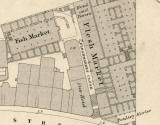
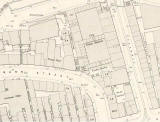
Thank you to Bryan Gourlay for sending me the
comments below about Fleshmarket Close, backed up by large-scale maps of
the close, dated 1849-53, 1876-77 and 1893-94.:
Bryan wrote that it was interesting to look at the changes that took
place in Fleshmarket Close during the 19th century. |
|
1849-53
"The 1849/53 Ordnance Survey map shows the
close was an out and out drinking den lined by pubs on both sides, in
front of the flesh and poultry markets – perhaps a place to avoid on your
way home of an evening. This was before Cockburn Street was
constructed some time in the 1850s.
The only buildings on Fleshmarket Close named on this map are:
- EAST SIDE: 3 taverns (at N end)
+ poultry & veal market (at S end)
- WEST SIDE: tavern, Black Bull Inn, hotel & tavern
(all at S end)
|
|
1876-77
"By the time the 1876/77map was published, the
flesh market seemed to have pushed some of the pubs out of the way, and
there was a large fish market at the bottom, adjoining Market Street.
Perhaps it was a bit messy underfoot?"
The buildings on or beside Fleshmarket Close named on this map
are:
- EAST SIDE: hotel & tavern (N)
+ flesh market (large) + poultry market
(small)
- WEST SIDE: fish market (in Market
Street) + Star Hotel (on corner of Cockburn
Street)
©
|
|
1893-94
"By the time the 1893-94
map was published, the flesh and poultry markets are still there, but it
is not clear whether the building shared with Market Street still housed
the fish market"
The buildings on or beside Fleshmarket Close named on this map
are:
- EAST SIDE: public house (S),
City Flesh Market ( large) poultry
market (small)
- WEST SIDE: 2 public houses (half way
up the close)
©
|
|
Bryan Gourlay, Biggar, Lanarkshire, Scotland: August
19, 2008 |
|
Answer
8.
Joyce Messer
North Island, New Zealand |
|
Thank you to Joyce Messer who wrote |
|
'To Plowt'
"My mother used to talk about the rain
'plowting down'. I wonder if there is a connection between that word
and the French 'pleuvoir - rain' (or the Eng 'pluvial' ).
There are many Scottish words that have French
connections via Mary Queen of Scots, eg 'tassie' for cup.
I'm not an expert so this might be all
nonsense to a lexicographer!"
Joyce Messer, North Island, New Zealand: August 29,
2008
|
|
Answer
9.
Bob Wyllie
Brussels, Belgium |
|
Thank you to Bob Wyllie who wrote |
|
'The Plowt'
"When I was a child in the 1940s, I always
knew of Fleshmarket Close as the Plout. That's what my parents
called it and that's how, in my mind, I spelled it never having seen the
name written.
Pet Shops
There were several pet shops down the length
of The Plout then. It had that typical smell of places where many small
animals are bedded down on sawdust - not unpleasant but very
distinctive.
There must have been many more pet shops in
the past. My father used to tell me how you could lose your dog at the top
of the Plout and then buy him back again from a shop when you got to the
bottom.
Bob Wyllie, Brussels, Belgium: October 12, 2008
|
|
Answer
10.
Eric Gold
East London, England |
|
Thank you to Eric Gold who wrote |
|
Pet Shop
"I remember a wee pet shop in Fleshmarket
Close. It was dead opposite the Scotsman Newspaper company.
The chap who ran it had either his twin brother or son working there and
they were like two peas out of a pod. They were great and I used to go in
regularly.
I bought a ginger kitten thee, when we lived
in Craigmillar and he was a great cat. The shop had a big cage full
of rats and I was frightened of them, although they were white and
domestic pets. The day I bought Ginger as wee kitten he hissed at the rats
(ha ha ha ha) and the owner told me, "He'll be a great rat catcher, mice
too." and he was right. Ginger killed the mice in Craigmillar.
Luckily there were no rats there like we had in Arthur Street.
The owner and his son or brother were great to
me and I bought all my pet food from them. He said, jokingly, "You
can have a rat free of charge (ha ha ha ha)."
I would run down the close, past the pub
called the Half Way Hoose. I’m sure the pet shop owner came from the
Canongate area. I saw him in 1969 when I was on leave from a Cunard cruise
liner called 'The Caronia'. We had a good drink in the Mitre Bar in
the Royal Mile and he told me that he'd had enough and was selling up, I
wonder what became of the shop. I know it's not a pet shop any more."
Eric Gold, East London: October 12, 2008
|
|